


Meg Webster and the Beauty of Impermanence Webster’s immersive artwork embraces the tension between permanence and impermanence inherent in the natural life cycle
Since graduating with her M.F.A from the Yale School of Art in 1983, Meg Webster has earned an elite reputation in New York’s art world despite being relatively unknown in more plebeian circles. For decades, she has worked with various unruly organic materials like flowering branches, hay, liquid beeswax, local earth and sand to sculpt…

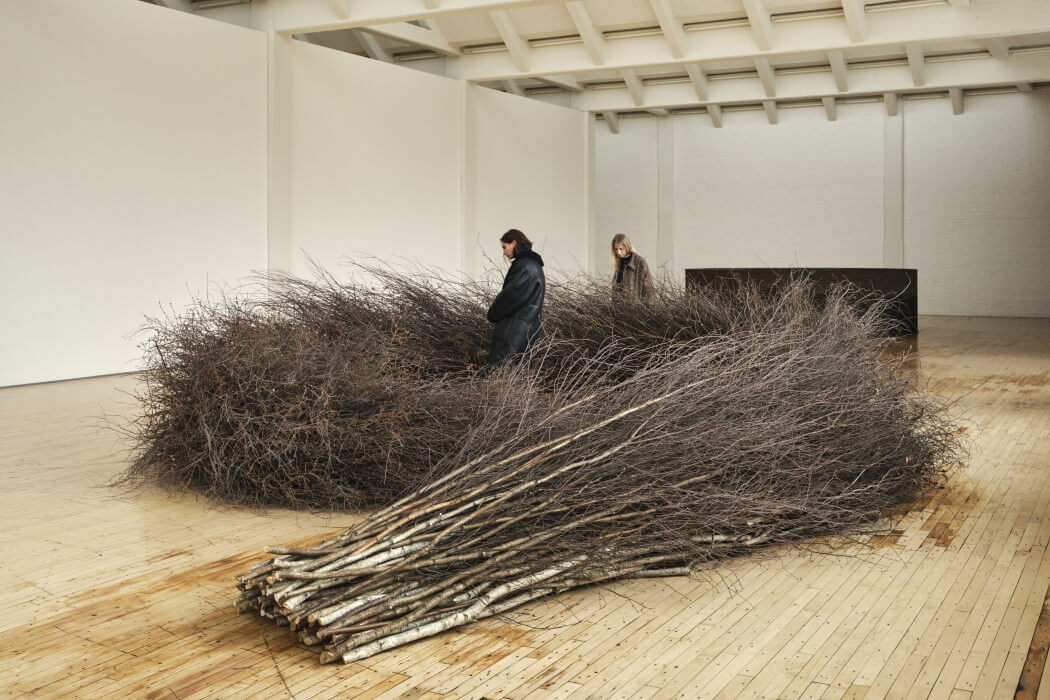
Since graduating with her M.F.A from the Yale School of Art in 1983, Meg Webster has earned an elite reputation in New York’s art world despite being relatively unknown in more plebeian circles. For decades, she has worked with various unruly organic materials like flowering branches, hay, liquid beeswax, local earth and sand to sculpt precise, symbolic geometric designs.
While some of her pieces could conceivably outlive her — Webster is currently 81 and battling Stage 4 breast cancer, according to the recent profile written by Zoe Lescaze in The New York Times Style Magazine — many exist only as long as they are on exhibit, intended to gradually erode and eventually be dispersed back into the environment from whence they came.
Webster’s Most Recent Exhibits
“Volume for Lying Flat.”
Dia Beacon, New York
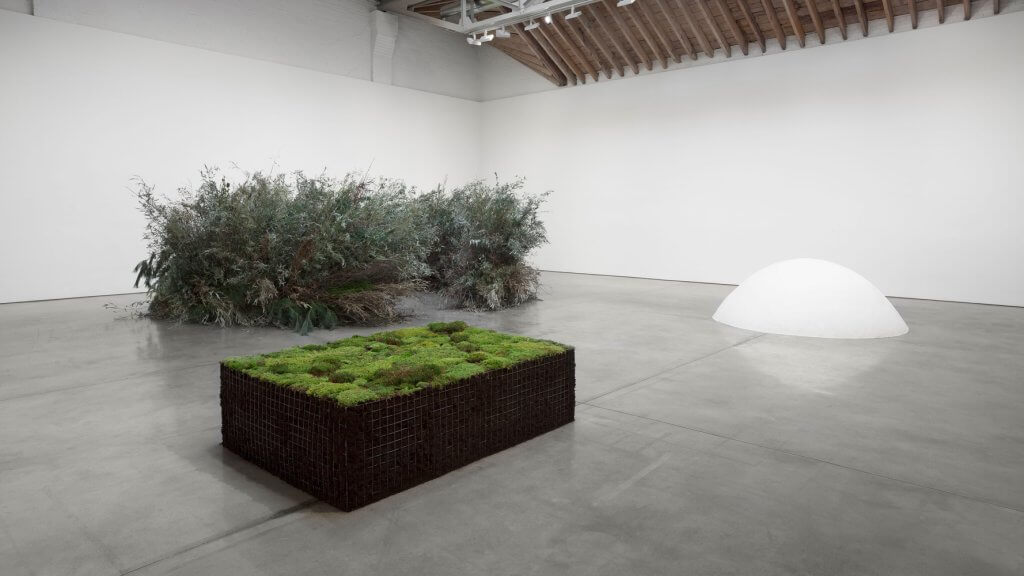
The long-term exhibition at the Dia Beacon museum in upstate New York, which ran from February 2024 to April 2026, is being hailed as one of the most important exhibitions of Webster’s impressive career. Featuring her signature concave and convex earthworks, complemented by sculptures constructed in beeswax, moss, salt, and sticks, the exhibit is a study in entropy, prone to cracking, fading, and disintegration.
Comprised of nine large-scale sculptures, five of which are now in the Dia’s permanent collections, Webster’s installations join “strict, minimal geometries with the inherent looseness of natural materials,” the Dia’s press release described. “Webster’s works sustain both tension and stillness as the sculptural forms hold their shape against gravity and provoke a state of heightened attentiveness to nature.”
Paula Cooper Gallery, New York
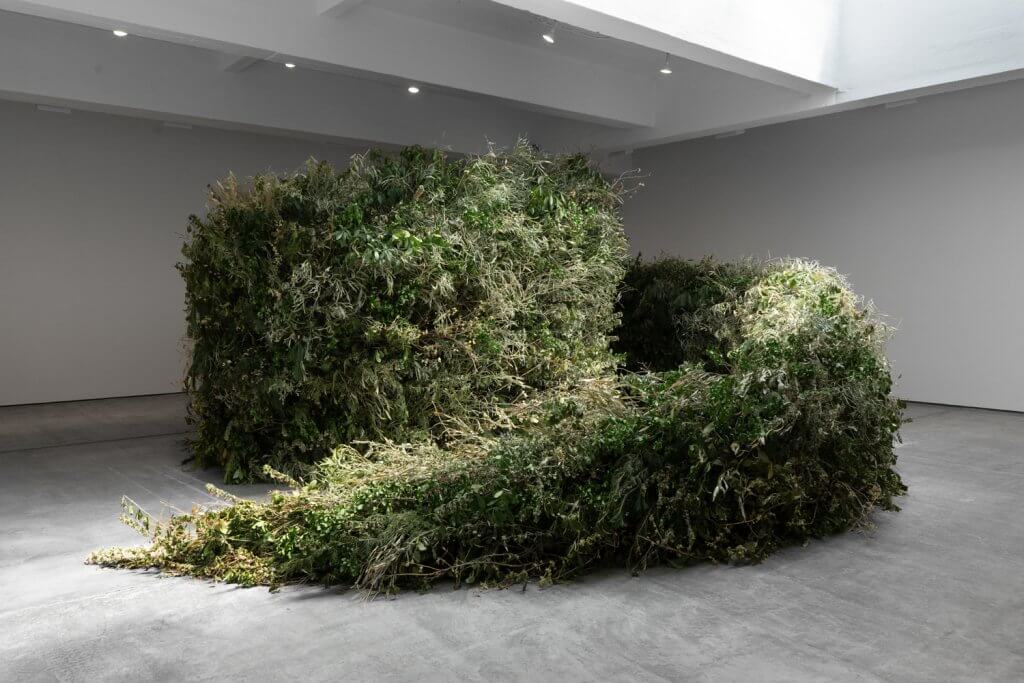
Running from May 9 through July 24th, 2026, the Paula Cooper Gallery’s exhibition of new sculptures and drawings by Meg Webster features a new installation called “Thicket.” Installed in situ, like most of her pieces, “Thicket” “layers plant cuttings into a dense, spiraling structure of leafy branches, berries, and flowering buds,” according to the Paula Cooper Gallery’s press release. “The spiral opens wide enough to allow the viewer inside, creating an immersive, enveloping space.”
Recurring Themes In Webster’s Art
Many of Webster’s largest pieces form enclosures similar to “Thicket”: places that welcome people in and force the body to become an active participant by engaging all five senses. The spiral motif is one that works well for this purpose, and is also seen in earlier works such as “Stick Spiral” (1986) and “Glass Spiral” (1990).
Webster’s debut piece, “Soft Broch,”(1984) was a conical shelter with sloping 10-foot walls made of hay. As Lescaze’s profile describes, “it was designed to make [visitors] viscerally aware of the hay — its prickles, its bulk, its barnyard smell — and of the other people sharing the intimate space.”
Over the decades, Webster conceived many of her signature works as responses to the prevailing crises of the times; in the 1980s, for example, many of her pieces were statements on the nuclear threats our country had been facing. Her first outdoor work, “Hollow” (1985), an interior room filled with cheerful, blooming flowers that contrasted with a barren, trenched entrance, is often interpreted as a message about the AIDS crisis. That year, art critic Gary Indiana wrote in the Village Voice, “‘Hollow’ makes you feel that living and dying are important processes to pay attention to, and that everyone is always doing both.”
Her most recent works, like those displayed at Dia Beacon, read as remarks on climate change, and as “templates for making art in a world overrun with stuff that never biodegrades,” Lescaze wrote.
“I’m not happy with [my installations] disappearing,” Webster told Lescaze. “But I’m not happy with them staying forever, either.”
The Unspoken Undercurrent of Loss
Although it is rarely openly addressed in critics’ interpretations of her work, Webster’s art is an ongoing dialogue about nature, the procession of time, and the cycle of loss and rebirth. For example, “Concave Earth” (1986-1990), a 23-ton column of dark gray-brown soil with a sunken top, needed repairs to survive the Dia Beacon exhibition. As Lescaze reported, Webster approved the restoration, but seemed to miss the ragged fissures museum staff had filled. From where we sit, it’s difficult not to draw comparisons between the piece’s decline and the process of aging: “It’s kind of wonderful to see it change and get awful,” Webster said. “You should’ve seen it before [the repairs], when the cracks were even bigger on the inside. It was primordial.”
Despite overt metaphorical references in her artwork, Webster herself seems to avoid directly addressing death or loss, treating the subject as an afterthought that might only now be occurring to her. During her interview with the New York Times Style Magazine, she almost flippantly revealed her breast cancer diagnosis, saying “It’s all right, I’m gonna make it,” after listing the treatments she’d already undergone. “I’m not dying. I can tell you that.”
And earlier in the interview, Webster tellingly remarked, “‘Loss is an interesting problem,’ […] while gazing absently at “Stick Spiral” (1986), a gyre of leafless branches circling around an empty center. ‘I wonder if that has anything to do with the works?’”
Nonetheless, Webster seems to take comfort in the fact that even though her installations are temporary, their ephemeral nature allows them to return from whence they came. “I love this piece,” she said about “Nearest Forest Soil,” (1987) a five-ton cylinder of gray earth. “They’re gonna have fun chopping it up. They have to put it out somewhere where it can be alive again,” she added to Lescaze. “They have to put it in the woods.”



-

A beautiful reminder that not everything is meant to last forever. Sometimes there is wisdom in embracing change, impermanence, and the natural cycles of life.
-
I just saw this show at the Paula Cooper Gallery in NYC. I’m a big fan of Meg’s work. It’s very site oriented, bringing the natural environment into the gallery space. The juxtaposition of natural to man made, combined with the impermanence is not the typical art experience. I was sad to read of her breast cancer. May she be well and live long to create her beautiful art.





Leave a Reply