

Living Organ Donation

Jump ahead to these answers:
What Are the Risks in Being a Living Organ Donor?
July 8th, 2025Being a living organ donor is a very noble thing to do. Although a person can live a long, healthy life with only one kidney, one lung or a portion of a liver, there are some risks involved. First, of course, are the “normal” risks of surgery and anesthesia. Removing an organ is a major procedure, and complications, such as bleeding, infection or delayed wound healing can occur. These are usually easily managed, however, and most donors are discharged from the hospital after a few days. According to data collected over the past 60 years, the risk of dying after donating a kidney is less than 0.03%, and the risk of major complications is less than 1%.
Additionally, there is the unlikely but real possibility that a kidney donor will suffer a catastrophic injury to their one remaining kidney. Or, more likely, that their remaining kidney will “give out” more quickly because it is doing the work of two. And, in fact, the incidence of kidney failure in people who have donated kidneys is higher than that of healthy individuals who have not. (It is still lower than the general population because kidney donors are carefully screened for chronic health conditions, while the general population includes many individuals who are chronically ill.) Still, the risk is quite small. According to one study from Norway, the incidence of end-stage renal disease in living kidney donors was less than 0.5% over 15 years.
Lastly, there are short-term financial issues that can impact living donors. In most cases, the cost of donation is covered by the recipient’s health insurance, but there are sometimes uncovered costs related to the surgery itself. Donors also must take time off from work (about a month on average after the surgery) and may be forced to use sick time or vacation time during that time. If they have to travel to the transplant center for evaluation and testing, those costs, including airfare, food and lodging, may be out of pocket as well. According to the Living Donor Toolkit from the American Society of Transplantation, the average living organ donor spends about $5,000 on out-of-pocket expenses. Financial help may be available, however, so check with the transplant center you are working with to learn if there are resources available to you.
Sources
“Reassessing Medical Risk in Living Kidney Donors”. https://www.kidneyregistry.com/wp-content/uploads/2021/03/Reassessing-Medical-Risk-in-Living-Kidney-Donors.pdf
American Society of Transplantation: Living Donor Toolkit: https://www.livingdonortoolkit.com
“Risk in Living Kidney Donors”. Journal of the American Society of Nephrology. https://pubmed.ncbi.nlm.nih.gov/30858158/
What Is Living Organ Donation?
July 8th, 2025As the term implies, living organ donation happens when a live person donates an organ to someone in need of a transplant. At the present time, the most common organ donated from one living person to another is a kidney. Nearly 6500 kidney transplants from live donors occurred in the U.S. in 2022 alone. A living person can also donate a portion of their liver. Since the liver is the only organ in the body that will regenerate, the donor’s liver grows to normal size again within a few months, while the transplanted liver tissue gives the recipient a new chance at life. More than 600 live transplants involving living donors occurred in 2022, setting an annual record. You may also be able to donate a lung or part of a lung, a portion of your intestines, or part of your pancreas. However, as of this writing, these transplants are quite rare.
According to the United Network for Organ Sharing, there are two paths to live-donor organ donation: Directed donation and paired donation. In directed donation, the donor specifies who is to receive the donated organ. This most often occurs when the donors are related by blood, (for example, siblings or a parent and child) since they are more likely to be an immunological match. However, it’s possible for an unrelated donor, such as a spouse or friend, to donate an organ if their blood and tissue types match the recipient. According to the University of Utah Transplant Center, one in four donations from living donors are from people who are not biologically related to the recipient.
Paired donation, on the other hand, is a pilot project sponsored by the Organ Procurement and Transplant Network that matches people who are willing to donate a kidney with unrelated recipients who need them. In far too many cases, a healthy person wants to donate to a friend or relative who is on the transplant waiting list, but is not a tissue or blood type match. The pilot program collects data on these individuals and matches potential donors with potential recipients by blood and tissue type. (See diagram below) At this time, kidneys are the only organs that are matched this way.
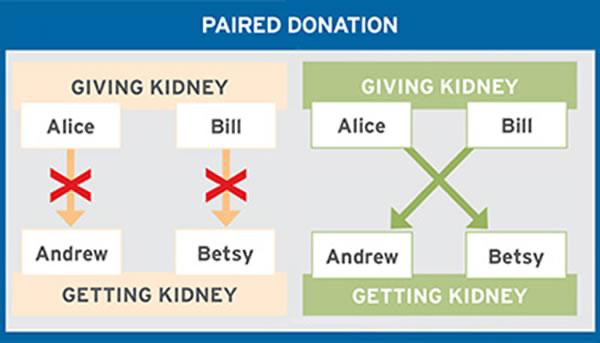
In the above example, Bill wanted to donate to Betsy and Alice wanted to donate to Andrew, but neither was a match. All four people were entered into the registry, and the computer matched Bill and Andrew and Alice and Betsy by tissue and blood type.
Sources
“Living Donation”. United Network for Organ Sharing. https://unos.org/transplant/living-donation/
“Kidney Paired Donation”. Organ Procurement & Transplantation Network. https://optn.transplant.hrsa.gov/professionals/by-organ/kidney-pancreas/kidney-paired-donation/