

An Interview with Sherri Lynn WoodAn interview where Sherri guides us in the process of healing through quiltmaking.
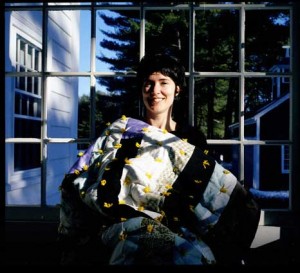
Dana: How does passage quilting help guide people through the bereavement process? Sherri: Quiltmaking has historically been a part of women’s storytelling and women’s expression. People have always made quilts as memorials to lost loved ones, whether they have thought of the process or not. The process is really about relationships, and there are parallels…

Dana: How does passage quilting help guide people through the bereavement process?
Sherri: Quiltmaking has historically been a part of women’s storytelling and women’s expression. People have always made quilts as memorials to lost loved ones, whether they have thought of the process or not.
The process is really about relationships, and there are parallels in the process of making the quilt to the bereavement process. Creating the quilt creates a safe container for people to stay grounded while they process their grief. They can focus on learning real skills –sewing, putting together the materials, learning the craft – to couch and to reflect the internal process:
1. Gather the materials. This is an opportunity for people to share memories and tell stories as they choose the clothing that has the most memories and the most meaning attached to it. They have to be thoughtful of choosing clothing that is the most descriptive of the person. A lot of people find comfort in sharing that process with me, as the facilitator. A lot of people will tell me the story of how the person died, and share memories of the person with me, and that sharing is really important to a lot of people.
2. Tearing or cutting clothes apart. This can be really intense for some people, and sometimes they don’t even want to be a part of this step; sometimes they want to do it on their own. This is the point where people have to acknowledge that the person is really gone, that they will no longer be around to wear these clothes.
3. Piece the quilts together. I use an improvisational process, which is pretty unique. I discourage people from trying to create a pattern have a preconceived notion of what they want to create. Instead, I encourage them to work with the architecture of the clothing itself, which is important in two ways:
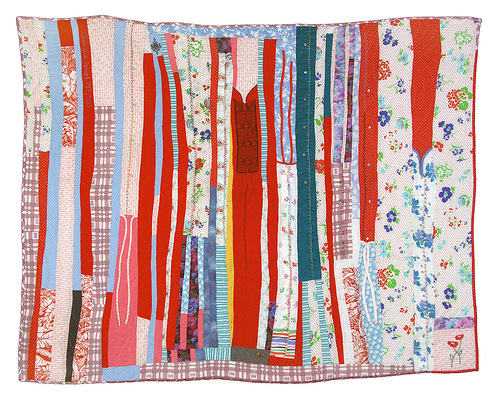
First, preserving the architecture of the clothing preserves the essence of the body of the person who wore it – their height, or shape, or the design of their favorite dress, for example.
Second, it’s very much like the grieving process, in which the regular patterns of your life have been disrupted. As you go through the grieving process, your patterns have to be recreated, and you don’t know how they will evolve. With improvisational quilting, it’s very much the same. People don’t know how the quilt will evolve. They have to trust the process. And people always see the beauty of what they have created in the end.
The process of piecing together the quilt really touches on relationships. As people are connecting the materials, they are thinking artistically about creating relationships with the patterns and fabrics, but they are also creating relationships between the memories attached to those clothes. By going through this process, they are transforming the relationship with the person.
4. Quilting, piecing together the 3 layers that make up the actual quilt. Until now the process was just creating the top layer. In any situation, quilting is very meditative. You’re in the same posture you are in in mediation or prayer: bent head, heart centered between your head and your hands, your hands moving rhythmically. The process is very slow; it takes a long time, and it allows the person to meditate on their memories.
Quilting also allows a person to choose when they will face those memories. They can say “I’ll allow myself to be involved in the memories and set the time that I want to do it.” Then they can put it away when they want and pull it back out when they want. It’s important for the person to know that the quilt is still there and they can pull it out anytime and interact with those memories.
5. Having the object itself. Finally, at the end of the process, people have the quilt which can be a great comfort. The object holds memories and stories, and they can bring it out and wrap up in it anytime.
Having the object can also be a vehicle for storytelling. Particularly with difficult deaths, it can encourage people to feel comfortable talking about the issues that are awkward to bring up. Having the quilt helps surpass the facts surrounding the death, because it is about who the person was, not about how they died.
Dana: Do you explain the parallels between the quiltmaking process and the grief process in your workshops or with clients, or do you just let people have the experience?
Sherri: I bring it up in a matter of fact way. I don’t explain it too deeply. I might say a couple of things about the benefits, like I’ll invite them to be present in the process. I’ll say something like, “Pay attention to the way you’re forming these patterns, it can teach you a lot about what’s going on internally.” But, I want people to have their experience. As a facilitator, I don’t think of myself as a counselor. My role is just to be present and give guidance, in terms of the skill.
People are able to be grounded in the process of learning this new skill. My role is to teach them the skills and to be present to any kind of emotions that come up through the process.
A lot comes out in the workshops. Usually I’ll open and close the workshop with sharing and reflecting, and especially when the workshop is more than one day, they have time to think about reflections and come back, a lot comes out. Everyone is going through a transition, and the workshop becomes a community forum where people can share. That process is very grounding.
Dana: Do you always bring it back to healing, rather than focusing on learning the skills of quilting?
Sherri: Yes. It’s always about the process of healing. As an artist I can have an aesthetic judgment about their work, but that’s really of no importance. No one ever looks at what they’ve made and thinks “I don’t like the way this looks”. When people ask me what will look best, I encourage them to do what is pleasing to their eye, to use their intuition to create the piece aesthetically.
Dana: How did your quiltmaking evolve into the hands-on grieving and healing process of “passage quilting”?
Sherri: Passage Quilting evolved out of my practice as a quiltmaker and as an artist after 911 and around the Spring of 2002. I’ve made quilts by commission a lot, and people would hang them in their living room or whatever, but I got to a point where I was tired of creating just objects. I had a desire to do more service-oriented artwork.
People would come to me with clothes and things to make quilts, and it occurred to me how much meaning clothing and materials carry, the narrative that exists in them. I wanted to have more interaction with my clients and doing something more meaningful, so I made this conscious decision to move toward service-based rather than object-based work.
Dana:You said you wanted to get into service-oriented work. How did you get involved with healing and grief in particular?
Sherri: I made a conscious decision as I evolved as an artist to do social practice. There are so many different directions you can go to as an artist.
I had some difficulty with depression when I was younger, and when I started quilt making it was very healing for me. I wanted to interact with people, do stuff that connects to my life, and now that I feel more healed, I want to figure out ways that my creative work can do that for other people. It just made sense to me to go to healing, because that was what had driven my creative work.
I started with traditional quilts, but when I started the improvisational quilts, it became a healing process for me. When I became a professional artist, I had to start making decisions about what kind of work I was going to do. And I wanted to continue to do meaningful work.
Dana: What made you start improvisational quilting?
Sherri: I was always looking for a more free way of making quilts. I had all of these rules about quiltmaking, and I wanted to break out of that. Then I saw an exhibition –Who’d a Thought It? – very shortly after I started making quilts, of African American improvised quilts. It was the first time they had been exhibited in a museum, and that was the first time I’d ever seen that type of quilting. Improvised quilts are so alive and present. That had a profound influence on me.
I learned more through taking workshops, and later I started discovering things like how fabric can carry narrative, which is what led to Passage Quilting. The rhythm of intention became very fascinating to me. I became very fascinated by pattern-making and the intention and the presence that’s required for improvisation. As I’m making these quilts, I’m always learning something about myself and the way that I make patterns in my life.
Dana: Is there anything else you would like SevenPonds readers to know?
Sherri: The idea that anyone can do is really important. It can be as a community project, it doesn’t have to be done individually. Making one quilt can be a good project for communities and families to go through the process together and share those memories with other people.
Dana: Thank you so much for your time, Sherri!
Sherri: Thank you for including me; I really love what you are doing with SevenPonds, and I’m happy to be a part of it.
May We Suggest:
 What Is a Memorial Quilt? (Interview)
 Passage Quilting Aids in the Grieving Process
 What to Do When Someone Dies
-

Sherri,
Thanks for sharing your work, process and stories with us. It’s such a soulful process with years of return towards healing. You also have a wonderful eye for color, texture and pattern. It’s great to offer you as a resource to our readers at SevenPonds!
-
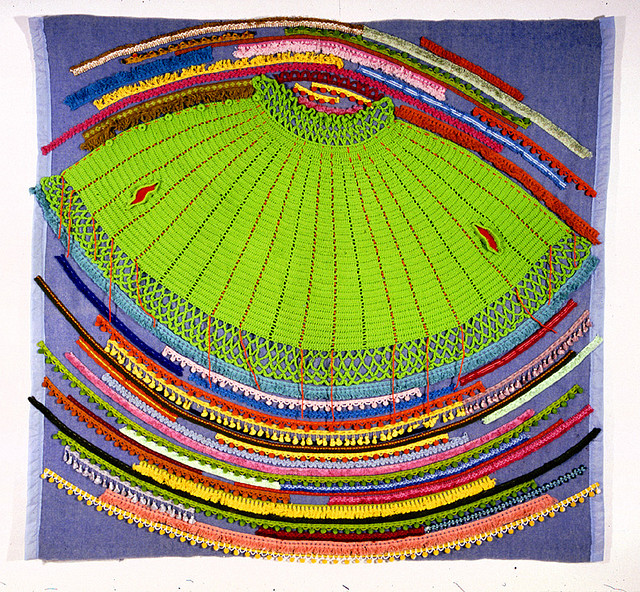
I adore Sherri Lynn’s work. The colors and lace designs are gorgeous and has inspired me to make a blanket from my mom’s old sewing trims and fabrics. The image has such beautiful colors and ideas to help me begin a project to sew something with my hands while I cry. I miss my mom so much.
-
Thank you for this resource to have a memory quilt sewn in memory of my mother. She made many quilts during her life and she always favored red velvet squares mixed with all kinds of colorful patterns. I will have some of her dresses sewn with red velvet squares as a wall hanging for my home. My wife will appreciate this too as she got alone surprisingly well with my mother. Thankfully we have not cleaned out her closets yet.
-
Gorgeous!
-
Thanks for this thoughtful interview. I’m honored to be included on your blog. What a wonderful resource for people living through the end of life.





Leave a Reply