


“Body and Soul” Art Exhibit at Bourse de Commerce in ParisThe multimedia show explores the connections between the body, life, and death by bringing together a diversity of contemporary artists
For its “Corps et Âmes” exhibition, the Bourse de Commerce in Paris brings together 100 artworks including drawing, painting, sculpture, photography and video. The multimedia show — in English, the title means “Body and Soul” — features works from over 40 artists in the Pinault Collection who come from different backgrounds. Though these artists span…


For its “Corps et Âmes” exhibition, the Bourse de Commerce in Paris brings together 100 artworks including drawing, painting, sculpture, photography and video. The multimedia show — in English, the title means “Body and Soul” — features works from over 40 artists in the Pinault Collection who come from different backgrounds.
Though these artists span medium and culture, they all explore what it means to live in a body, and many show the impermanence that is a part of being human. The show brims with diverse and thought-provoking perspectives, death surfacing as a theme throughout, as it is inseparable from the corporeal experience.
To accompany the exhibition, the Bourse de Commerce produced a 48-page press kit with extensive descriptions of artists and their works, and explanations as to why curators selected and placed pieces in the museum’s galleries as they did.
Death as a Bodily Experience in Corps et Âmes
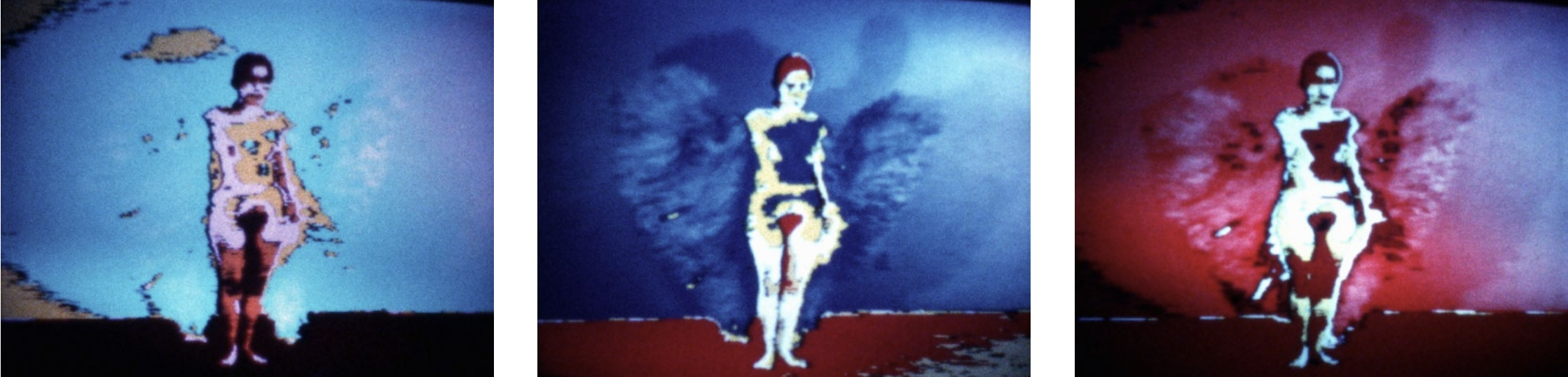
“Silueta Sangrienta” (1975), by video artist Ana Mendieta, evokes the idea of the body as permanent though ephemeral while returning to the Earth. It shows the artist in a series of images that flash on a screen for nearly 2 minutes. At first, she lies naked on a bed of earth. Then, her body becomes one with the earth. Finally, an imprint is left in the dirt, which is then filled with red lava — as the museum writes of the final image, what the viewer sees is “an intangible body of which only the radiance of its incandescent aura remains.”
That idea gets turned inside-out in the phantasmagorical portraits by Marlene Dumas and Miriam Cahn, each depicting a body against color. In Dumas’ “Birth” (2018) and Cahn’s “RITUAL” (2002), the human form takes on an almost ghostly quality akin to a lucid dream or otherworldly presence. The body is real and also spiritual.
In “Einder (Horizon),” 2007‑2008, another painting by Dumas, fresh flowers sit on her mother’s poetically rendered dark blue grave, one with a landscape at night. It “suggests a sense of the finite, an unattainable horizon, a journey towards a landscape of the beyond,” according to the museum. As Dumas herself wrote, she wanted to depict “something endless” in contending with death and loss.
In tandem with that imagery, another video installation by Mendieta in the same gallery evokes the same sentiment and develops it. “Flower Person, Flower Body” (1975) shows a collection of flowers floating in water. The waves begin to break up the body of them, and they separate, as if departing were a natural act. It suggests that we all depart in the end, as we took off on a journey in the beginning.
Life as a Journey to Death and Rebirth
In the same gallery, Peter Doig’s painting “House of Music” (2023) beautifully depicts that idea as a group of musicians sailing across the ocean on a small ship, as if the soul were on a journey upon the surface of consciousness. Moreover, there’s belonging and community in it. We’re all on the essential trip through life; it might not be the same one, but it unites us with every living thing in it.
In the last gallery, the curators seem to draw connections between the end and beginning of life by putting Georg Baselitz’s “Avignon” (2014) and Mendieta’s video “Butterfly” (1975) in the same room. Indeed, Baselitz opened the show, so it comes full circle.
In the vestibule, viewers encountered Baselitz’s 2003 “Meine neue Mütze (My New Cap),” a colossal boy sculpted out of cedarwood holding a skull behind his back. In the last gallery, viewers see “Avignon,” a gigantesque series of eight naked bodies hanging upside down – as described in the press kit, “a theater in which the aging body is the sole actor.”
But viewers also see Mendieta’s film, which depicts a chrysalis-body becoming a butterfly. The contrast of “Avignon” and “Butterfly” in the same space seems to acknowledge the final step for the human body: death. But the finality is ambiguous. The chrysalis shows, as press kit notes, “the promise of rebirth” and “the continuity of life after death.”
Many of the artists in the show express the impermanence of the human form, death as a bodily experience, and the belief that we might just keep becoming in the end — even take off with wings.
The exhibition will close on August 25, 2025.





Leave a Reply