


New Evidence of Medieval Mortuary Rituals from Laos’ “Plain of Jars”The mysterious stone megaliths that dot the Laotian landscape are finally starting to reveal their secrets
A new archeological study has revealed compelling evidence that the mysterious giant stone urns scattered across north-central Laos were used in mortuary practices during the Iron Age. Scientists have long suspected that these hollowed-out megaliths had something to do with internment of the dead, but had been previously unable to offer irrefutable evidence. With information…

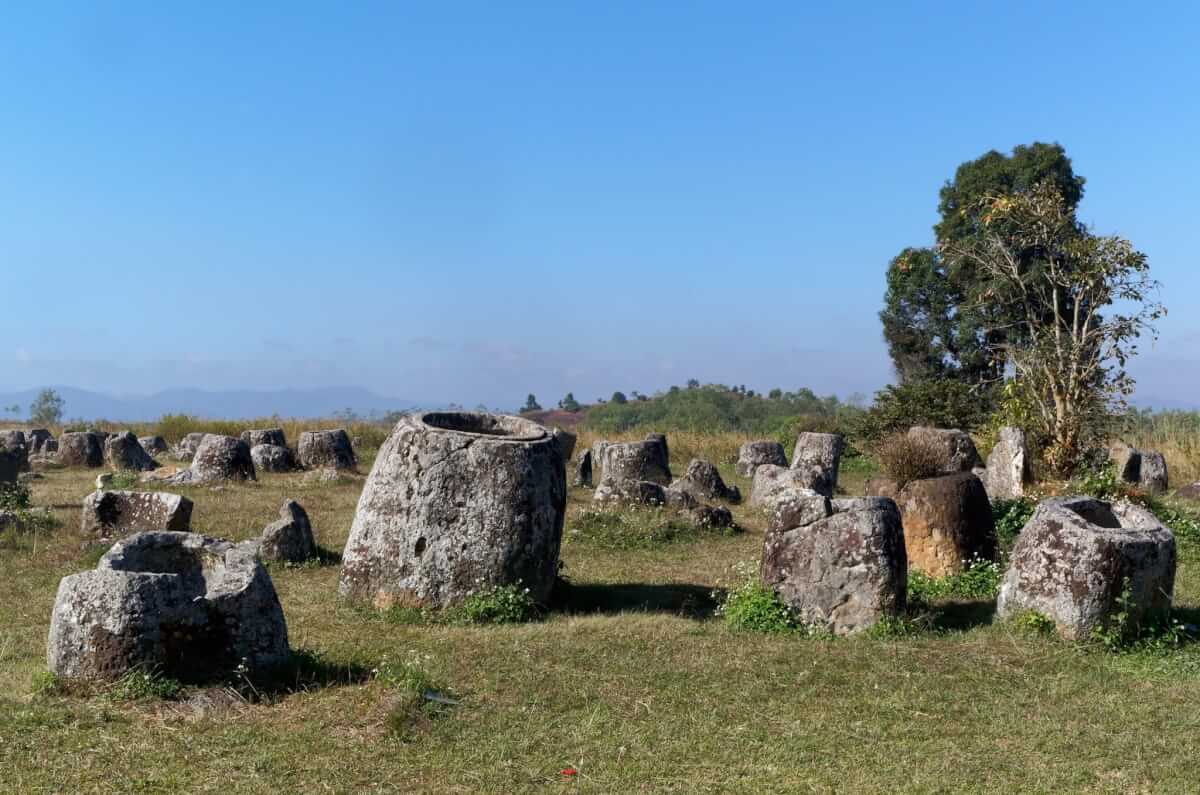
A new archeological study has revealed compelling evidence that the mysterious giant stone urns scattered across north-central Laos were used in mortuary practices during the Iron Age. Scientists have long suspected that these hollowed-out megaliths had something to do with internment of the dead, but had been previously unable to offer irrefutable evidence. With information gleaned from this most recent study, scientists are hoping to gain a better understanding of the cultural rituals and evolving community traditions of the people who once lived on the windswept Xieng Khouang Plateau, otherwise known as “The Plain of Jars.”
Discerning Fact from Folklore
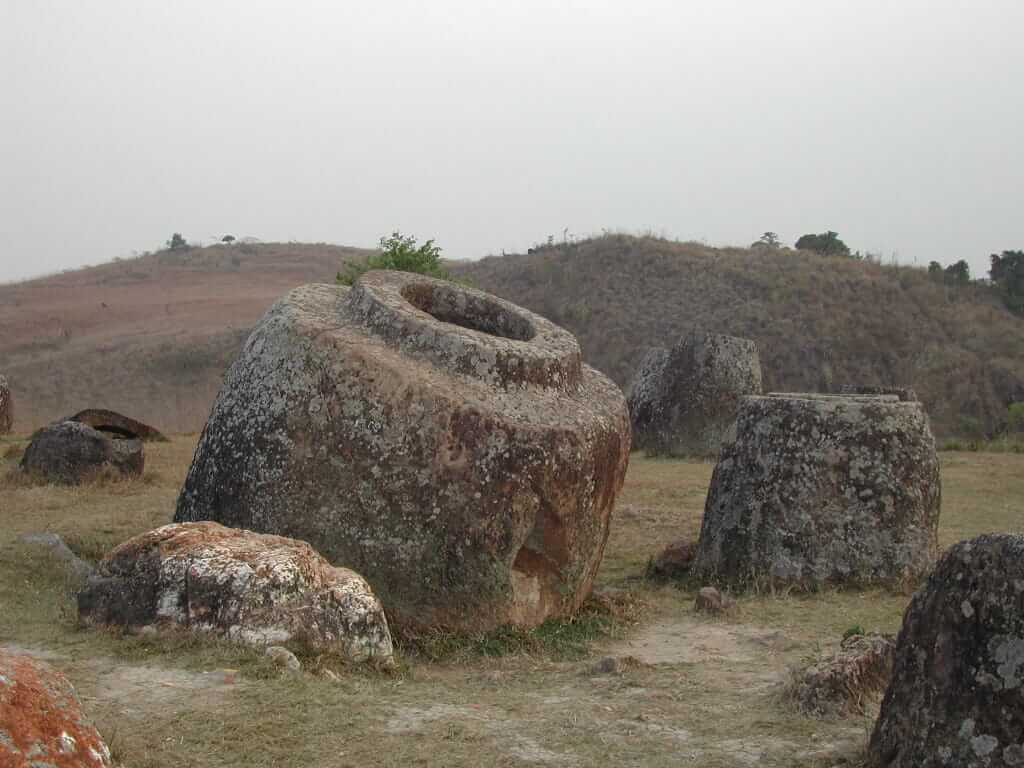
Hundreds of these three- to ten-foot-tall stone urns are strewn across the grassy plain, some squat-shaped, some slender, and others that may have started as mathematical prisms before the winds and the rains eroded their edges. Some stand rigidly erect across jagged ridges, while others lie in repose against the sloping landscape.
According to local folklore, ancient giants carved the stone urns to brew celebratory rice wine, but anthropologist Russel Ciochon reports a slightly different story in the Asia-Pacific Journal. Local inhabitants told him that the jars were made to celebrate a great military victory, over 1,500 years ago:
“The plain, so the story goes, was ruled by an evil king, named Chao Angka, who oppressed his people so terribly that they appealed to a good king to the north, named Khun Jeuam, to liberate them,” Ciochon wrote. “Khun Jeuam and his army came, and after waging a great battle on the plain, defeated Chao Angka. Elated, Khun Jeuam ordered the construction of large jars to be used in making wine for a victory celebration.”
Whatever grain of truth the lore retains, archeologists are now able to confirm that brewing wine was not the urns’ original intended purpose. Similarly, Ciochon found that when locals were asked about the jars, they often claimed that the relics were molded from a mixture of sand, sugar and buffalo hide. To the contrary, Ciochon reports that Luis Gonzalez, a sedimentary geochemist at the University of Iowa, examined a section of a jar from Lat Sen and found the material was a natural sandstone consisting mainly of grains of quartz, potassium feldspar and muscovite mica cemented by a clay matrix.
Archeological Excavations of the Urns
In the mid-1930s, pioneering French archeologist Madeleine Colani was one of the first researchers to share the Plain of Jars with the Western world, in her lengthy monograph, “The Megaliths of Upper Laos.” When she began exploring at Ban Ang, one of the main artifact sites, much of the jars’ contents had already been looted. But excavations around the jars revealed bronze and iron tools, beads made of glass and carnelian, as well as other artifacts like bronze bracelets and bells. The presence of a nearby limestone cave with walls still heavily blackened from smoke led Colani to deduce that the artifacts were burial offerings, and the urns were built to hold cremated remains.
Since Colani’s time, there has been very little modern field research performed on the jars. Shortly after the publication of Colani’s work, Laos fell into an almost continual state of war — fought over successively by the French, the Japanese and the Americans — and then entered into an extended period of isolation until the early 2000’s.
Then, in 2013 UNESCO officially recognized the Plain of Jars as a major cultural heritage site, providing critical protections for the more than 2,100 megalithic stone jars and associated artifacts. Although official recognition was a crucial step towards developing the site (for tourism and further research), progress was glacially slow. The area continues to be littered with unexploded bombs and other ordnance dropped by American forces during the Vietnam War, making archeological pursuits there potentially dangerous. In 2016, a five-year project between the government of Laos and Australian researchers commenced, kicking off new archeological excavations in pursuit of answering the many questions surrounding the mysterious stone urns.
The Latest Discoveries and What They Might Mean
The latest discovery comes As the New York Times reported, the latest study’s authors “became intrigued by a peculiar, squat structure, roughly four feet tall and eight feet wide” during field studies conducted in the winter of 2022. After deciding to excavate the sediment that had accumulated in the vessel’s cavity, the team was astounded to discover that the vessel – named Jar 1 – was in fact packed with the jumbled, disarticulated remains of at least 37 people.
“Honestly, it was one of those rare excavation moments where everyone becomes very quiet,” Dr. Nicholas Skopal, an archaeologist at James Cook University in Australia and the lead author of the new paper, told the New York Times. “We expected archaeology, but not such a dense, intact concentration of body parts.”
What they discovered – a meticulously organized and artfully arranged communal ossuary – shattered the wine-vat legend once and for all.
The bones of the deceased range from those of infants to adults, and researchers believe they were placed into the “death jar” long after their deaths. Skopal believes that the communities who used the jars may have used smaller stone vessels nearby for the initial decomposition phase, allowing the flesh to break down before the remains were relocated and permanently laid to rest in the larger vessel.
Secondary Burial as a Ritual Practice
Secondary burial, a ritual in which bodies are first allowed to decompose elsewhere (through temporary entombment, exposure or smoke-drying) before the bare bones are then gathered together and interred collectively, was a widespread practice in Southeast Asia at the time scientists believe these jars were made – radiocarbon testing of Jar 1 showed that it had served as a shared burial center for roughly 270 years, from the ninth to the twelfth centuries.
Skopal hypothesizes that these urns are evidence of ancestral funerary rites that might have spanned generations. “Were the stone jars some way for the soul to be released and be prepared for the afterlife as part of ancestor worship?” he asked. “We are doing some DNA testing on these remains inside the jar. That will give us an idea of who these people were and how they were related to each other.”
In their article on the discovery, New Scientist magazine interviewed Marco Mitri at North Eastern Hill University in India, who has worked on similar stone jars in north-east India. He said that taken together, these archaeological finds are revealing an extensive cultural tradition amongst Austroasiatic populations, performed for hundreds of years. Similar rites are still carried on today in India, he noted, by an Austroasiatic group called the Khasi, who, after cremation, deposit bones in stone boxes called cists.
Much remains to be learned from continued analysis of Jar 1 and future excavations of the hundreds of urns that have yet to be examined. For archaeologists long fascinated by the Plain of Jars and its mysteries, the discoveries so far have raised as many questions as they have answered. Nonetheless, Nigel Chang, another archaeologist at James Cook University, who specializes in Southeast Asian prehistory, told the New York Times that the unearthing of Jar 1 offers “the most concrete, irrefutable evidence yet of how the vessels actually functioned in ancient mortuary practices.”
May We Suggest:
 20 Humorous Quotes About Funerals and Cemeteries
 How Can We Integrate Green Burial With A Conservation Land Trust? (Interview)
 What is Natural Burial? (Interview)
-

What a fascinating glimpse into how people centuries ago honored their dead. These discoveries remind us that the need to remember, ritualize loss, and maintain a connection with those who came before us is deeply human.
-
So true. Across cultures and centuries, the ways we mourn may differ, but the desire to honor our dead and keep their memory alive remains universal.
-




Leave a Reply