

Green Burial FAQs
Jump ahead to these answers:
- Can I Choose a Green Burial for a Pet?
- How Can I Wrap or Shroud a Body for Natural Burial?
- What Is a Shroud?
- What Is a Bier?
- What Is a “Green” Casket?
Can I Choose a Green Burial for a Pet?
July 8th, 2025Yes, it is possible to arrange a green burial for a pet, but most conventional pet burial practices already align with what is recommended for a ‘green pet burial’. As an example, if your pet wasn’t embalmed and is buried in a biodegradable container or simple cotton blanket rather than using a vault, this would be deemed a ‘green’ burial in alignment with the Green Burial Council’s standards.
While dedicated green pet cemeteries do exist and adhere to standards, they are less common in comparison to certified green green burial grounds for humans and they are not the only option for pet burials. As noted, what is recommended for a green pet burial is also applicable at conventional pet cemeteries. Whole-family cemeteries are another option and are generally open to allowing pets to be buried in family plots. Likewise, burying your pet at home is almost always an option with some exceptions.
Be mindful that there may be regulations and ordinances regarding pet burials on your property. For many, burying a pet at home is a common and meaningful choice. It is generally permitted in most locations, but it is crucial to be aware of any local ordinances that may restrict it, especially for certain property types or within city limits.
Sources
“Green Pet Cemeteries”. Green Pet Burial Society. https://greenpetburial.org/providers/
“Five Green Ways to Honor Your Departed Dog”. Green Burial Council. https://www.greenburialcouncil.org/green_burial_council_blog/five-green-ways-to-honor-your-departed-dog
“Deceased Pet Care: Burial and Cremation Options”. PetMD. https://www.petmd.com/dog/care/deceased-pet-care-burial-cremation-options
How Can I Wrap or Shroud a Body for Natural Burial?
July 8th, 2025Instructions for wrapping shrouds are usually included with the shroud packaging, as the technique can vary depending on the type of shroud that was selected. The following method applies to shrouds with and without handles. Please note, custom-made shrouds may require unique wrapping techniques, so it is generally advised to reach out to the manufacturer or distributor for guidance. Most shrouds are used in natural or green burials, although they may also be used in cremation.
Whether the shroud of choice comes with or without handles, always begin by unfolding the shroud on a clean dressing table. Most shrouds are long and may drape on the floor, so you should ensure that the surrounding area is also clean. For a shroud without handles, begin by flipping the shroud so that the hemmed edges face upwards. Gently lay your loved one onto the shroud and make sure that the shroud covers the feet by folding it over them. Cover the body by folding the corner diagonally from the foot to the opposite shoulder and then from the shoulder to the opposite foot. Once this is done, fold the shroud’s end over the head and fold the sides inward over the body. At this stage, your loved one is wrapped in the shroud, so you should secure it by sliding the ties beneath the shroud and fastening them gently. When transporting your loved one in a shroud without handles, remember to do so using a casket or a willow carrier.
The technique for wrapping a shroud with handles is similar, but with a few variations. Flip the shroud so that the pouch faces upwards and the handles face downwards. If you are using a board, insert the end of the board into the pouch and slide it into position, then gently place your loved one onto the shroud. Ensure that your loved one’s body is centered on the board, keeping in mind the need to effectively support body weight. Ideally, position the board between the top of the neck and the back of the ankles. Fold the shroud over the feet and cover the body using the same method that you used for the shroud without handles. After the shroud’s end is folded over the head and the sides are folded inward towards the body, secure the shroud by fastening the ties into a bow. The handles on this type of shroud make it easier to transport your loved one by directly lifting. You should always use the handles on the shroud and avoid dragging it to prevent any potential tearing.
Wrapping a loved one in a shroud is a deeply personal and emotional experience, so it’s important to take time and allow yourself to fully be present in the process. Practicing the processes outlined here can be helpful in allowing preparation for the actual shrouding process prior to burial or cremation. Many people have found that practicing with a relative or a friend can make it easier to understand what to expect. Asking a funeral director or home funeral guide for help is also greatly encouraged, along with referencing tutorials or workshops for further guidance.
Sources
“The Basics of Green Burial Shrouding”. Green Burial Council. https://www.greenburialcouncil.org/green_burial_council_blog/the-basics-of-green-burial-shrouding
“Green Burial & Other Environmentally Friendly Choices”. Funeral Consumers Alliance. https://funerals.org/get-help/green-options/
“Shrouds and Carriers”. Interra. https://www.interraburial.com/products/shrouds-and-carriers
“DDLA: How to Shroud a Body”. Dive into Death. https://www.youtube.com/watch?v=OGj3ytyJrZc&t=41s
What Is a Shroud?
July 8th, 2025A shroud is a large piece of cloth that is wrapped around your loved one’s body before burial or cremation. Shrouds can vary based on cultural or religious customs and are made from various materials and fabrics. Most shrouds are made of biodegradable materials, making them a popular choice for green or natural burials. However, they can generally be incorporated into any funeral service. Shrouds can be as simple as a special blanket or sheet., though many individuals choose to personalize shrouds for their loved ones prior to use. There are also many customized shrouds that feature luxe fabrics, vibrant designs, patterns representative of traditions, or that contain practical additions such as handles, rigid boards for ease in transportation, and absorbent materials.
The shrouding process may be completed either by a member of the family, a loved one, or professional staff. In some cultural and religious contexts, shrouding can only be completed by specific relatives or by someone of the same sex. When shrouds are not used for cultural or religious reasons, the person tasked with wrapping the shroud around the body may vary based on comfort and experience level or previously expressed preferences.
If you or your loved one is seeking to be buried in a green cemetery or conservation area, these locations often have standards regarding shroud usage. They usually provide an outline of the specifications that must be met, such as the requirement for shrouds and clothing to be made from all-natural fibers to encourage natural decomposition following burial. Depending on the circumstances, the body of your loved one may be clothed or unclothed underneath the shroud. In regard to cremation, most states require that bodies be placed in a fully combustible, rigid outer container prior to cremation, such as a plain cardboard or plywood box. But this should not preclude the use of a shroud. As you are making arrangements for your loved one’s cremation, ask several cremation providers about their policies.
The decision to use a shroud is deeply personal and frequently influenced by religious, cultural, or environmental factors. For some, shrouds are an important part of preparing the body for transition into the afterlife. They may also be used symbolically to represent equality in death or preserve the privacy of the person who died. For the purposes of green burials, shrouds may be chosen to preserve the environment or natural resources by using fewer materials and avoiding items containing harmful chemicals. Regardless of the reasons behind the decision, shrouds are a dignified and respectful method for observing the funeral rites of a loved one.
Sources
“Shrouds for Burial or Cremation”. Fitting Tribute Funeral Services. https://www.fittingtributefunerals.com/shrouds
“Cremation Laws and How They affect Arranging a Cremation”. U.S. Funerals Online. https://www.us-funerals.com/understanding-cremation-laws-and-how-they-affect-arranging-a-cremation/
“GBC-Certified Product Providers”. Green Burial Council. https://www.greenburialcouncil.org/funeral_products.html
“On the Way to the Green Burial Cemetery: A Guide for Families”. Green Burial Council. https://www.greenburialcouncil.org/green_burial_guide_for_families.html
“What is a shroud and how do I find one?” Green Burial Project. https://www.greenburialproject.org/faq/what-is-a-shroud-and-how-do-i-find-one
“A brief history of shrouds and such”. Kinkaraco. https://kinkaraco.com/pages/history
What Is a Bier?
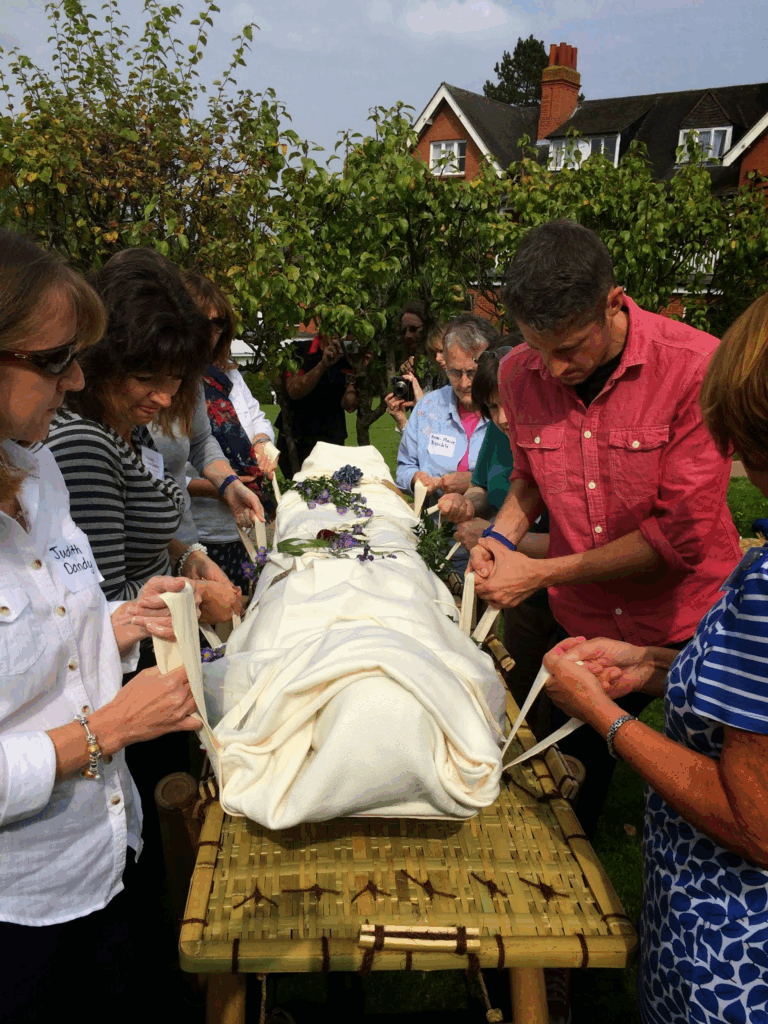
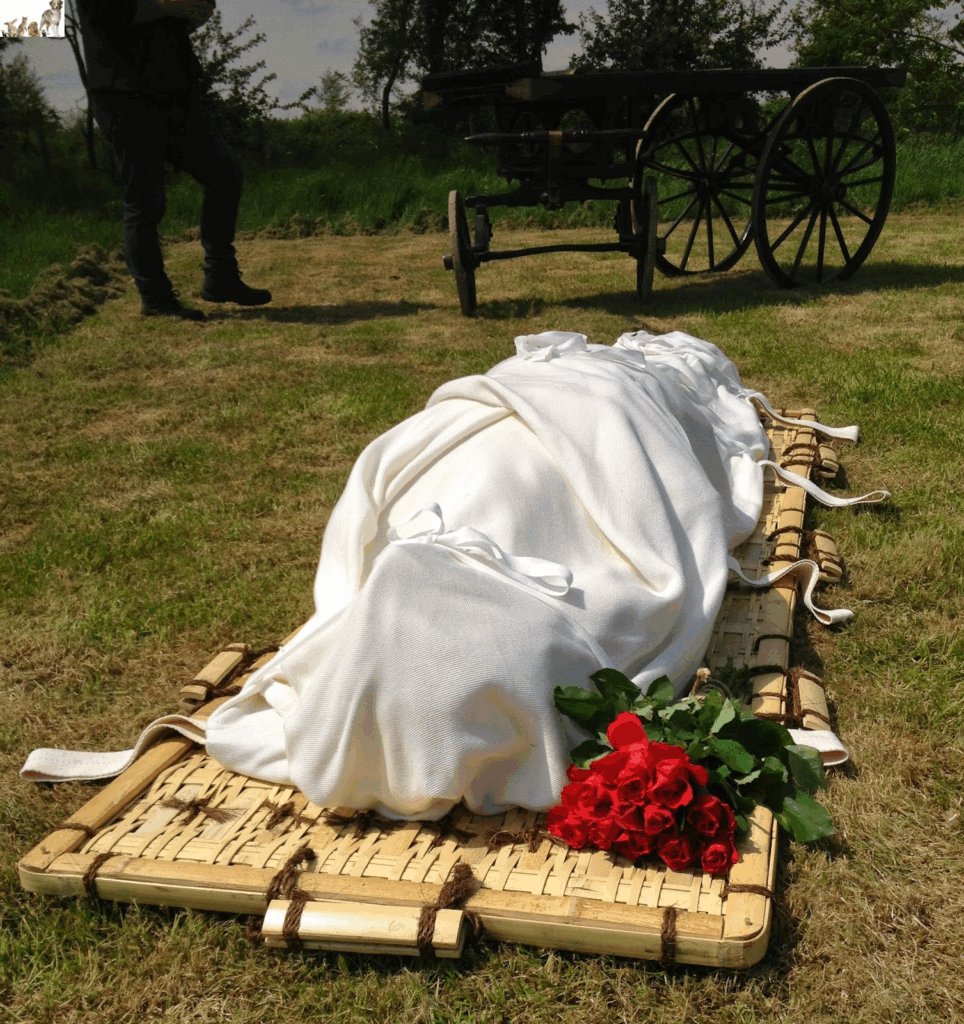
July 8th, 2025Because natural burial grounds eschew gasoline-powered engines and heavy machinery, most green burial grounds transport the casket or shrouded body to the gravesite on a platform or cart known as a bier. (See photos below)
In green burials, transporting and lowering a shrouded body can be a deeply personal and participatory part of the ceremony. Many cemeteries use simple, wheeled vehicles—such as retrofitted golf carts, wagons, or trailers—to carry both shrouded and casketed bodies to the gravesite. Some families prefer a more hands-on approach, choosing a processional with pallbearers who carry the casket on their shoulders or use a shrouding board with built-in handles to carry the body to the grave.
Lowering the body varies by cemetery and depends on the equipment available and the level of family involvement. While some cemeteries use machinery, such as hydraulic lifts or excavators, others hand-dig graves and offer families the opportunity to lower the body themselves using ropes, straps, or a shrouding board. In some cases, families may even request to dig the grave themselves. Because green burial encourages meaningful family participation, operators should be ready to support this with appropriate tools and clear guidance.
To manage safety and liability, cemeteries typically provide guidelines and require families to sign waivers if they wish to assist in digging or lowering the body. These measures help ensure a respectful, safe, and empowering experience for all involved.
What Is a “Green” Casket?
July 8th, 2025A green casket can be any biodegradable container suitable for holding a body. According to Green Burial Council standards, it should be made from natural or recycled plant, animal or unfired earthen materials and contain no plastic, fiberboard, or metal. (Necessary hardware and fasteners are exempt from this requirement as long as they are not made of brass or chrome.) Some materials commonly used for green caskets include:
- Bamboo
- Rattan
- Hemp
- Organic wool or felt
- Organic cotton
- Seagrass
- Banana leaf
- Teak
- Willow
- Reclaimed, unfinished softwood
- Recycled cardboard
Keep in mind, however, that some biodegradable caskets may come with a rather large carbon footprint because the materials are grown far from where they are made. Bamboo, for example, is plentiful and sustainable since it grows at a rate of about 3-10 centimeters a day. But the vast majority of bamboo used in the U.S. is grown in China and, to a lesser extent, South America. Thus, even if you buy a bamboo coffin made by hand by local artisans, the carbon cost of getting it to the manufacturer in the U.S. may be quite high.
Cork, too, is an extremely sustainable resource. It is actually the bark of the cork oak tree, which can be stripped from the tree every 9-10 years without damaging its health. However, almost all cork used in the manufacture of coffins (and coasters and wine stoppers) comes from oaks grown in forests in Portugal and Spain, with a lesser amount coming from Morocco, Algeria, Tunisia, Italy and France. All of this raw material must be transported from the point of origin to the site where the coffin will be made and then shipped to your location, which can increase its carbon footprint a great deal.
This is not to say that wicker, cork, and bamboo caskets are not “green” in the strict sense of the word. But if you are opting for green burial because it is friendly to the environment, choosing a casket made from locally sourced pine or recycled cardboard might be a better choice.
Creating your own burial shroud or casket—or sourcing one from a local artisan—is a meaningful and eco-friendly option. Just be sure to check with your funeral or burial provider about size, durability, and handling requirements (like built-in handles or fit for transport and burial). Review the GBC’s product standards to ensure your design supports environmental goals. For handcrafted options, explore the Funeral Artisans Collective. Funeral providers are legally required to accept appropriate, outside products. For legal guidance on their responsibility to you as a consumer, see the Federal Trade Commission’s Consumer Advice page.
Ultimately, green burial products are designed to return the body gently to the earth while honoring both the deceased and the environment. Before purchasing or selecting any products, it’s a good idea to check with the burial ground or funeral provider to ensure they meet specific logistical and site requirements.
Sources
Funerary Artisans Collective. https://www.funeraryartisanscollective.org/
“The FTC Funeral Rule”. Federal Trade Commission. https://consumer.ftc.gov/articles/ftc-funeral-rule
“Our Standards”. Green Burial Council. https://www.greenburialcouncil.org/our_standards.html