

Burial & Cremation Options for Funerals
Jump ahead to these answers:
- What Is the Difference Between a Casket and a Coffin?
- What Is a Perpetual Care Cemetery?
- What Is a Companion Plot?
- How Long Does a Concrete Burial Vault Last?
- What Is an Oversized Casket and When Is It Necessary?
- What Is the Difference Between a Full-Couch and Half-Couch Casket?
- What Is a Destination Funeral?
- Can I Collect a DNA Sample From My Loved One Before the Funeral or Final Disposition Takes Place?
- What Is the Proper Way to Clothe My Loved One for Their Viewing and Burial?
- What Are Appropriate Items to Place in My Loved One’s Casket? What Items Are Not Permitted?
- What Is a Mausoleum Burial?
- What Are the Most Common Types of Burial Vaults?
- Can I Request to Have My Loved One’s Clothes Returned After the Viewing or Funeral?
What Is the Difference Between a Casket and a Coffin?
August 6th, 2025The differences between a casket and a coffin include their costs, shapes, and the materials involved in their construction. Outside of the United States, the terminology may also differ. For example, in Ireland, the term coffin describes a container suitable for a loved one’s funeral or burial. In contrast, the term casket may refer to a decorative container that holds items such as valuables or jewelry.
A few components contribute to the difference in shape between coffins and caskets. Most coffins have six sides and distinct tapering at the head and feet, whereas caskets have four sides and are more rectangular. While the lid of a coffin is flat and can be lifted for removal, the lid of a casket has a dome shape and is hinged so the lid can swing open to view the person who has died.
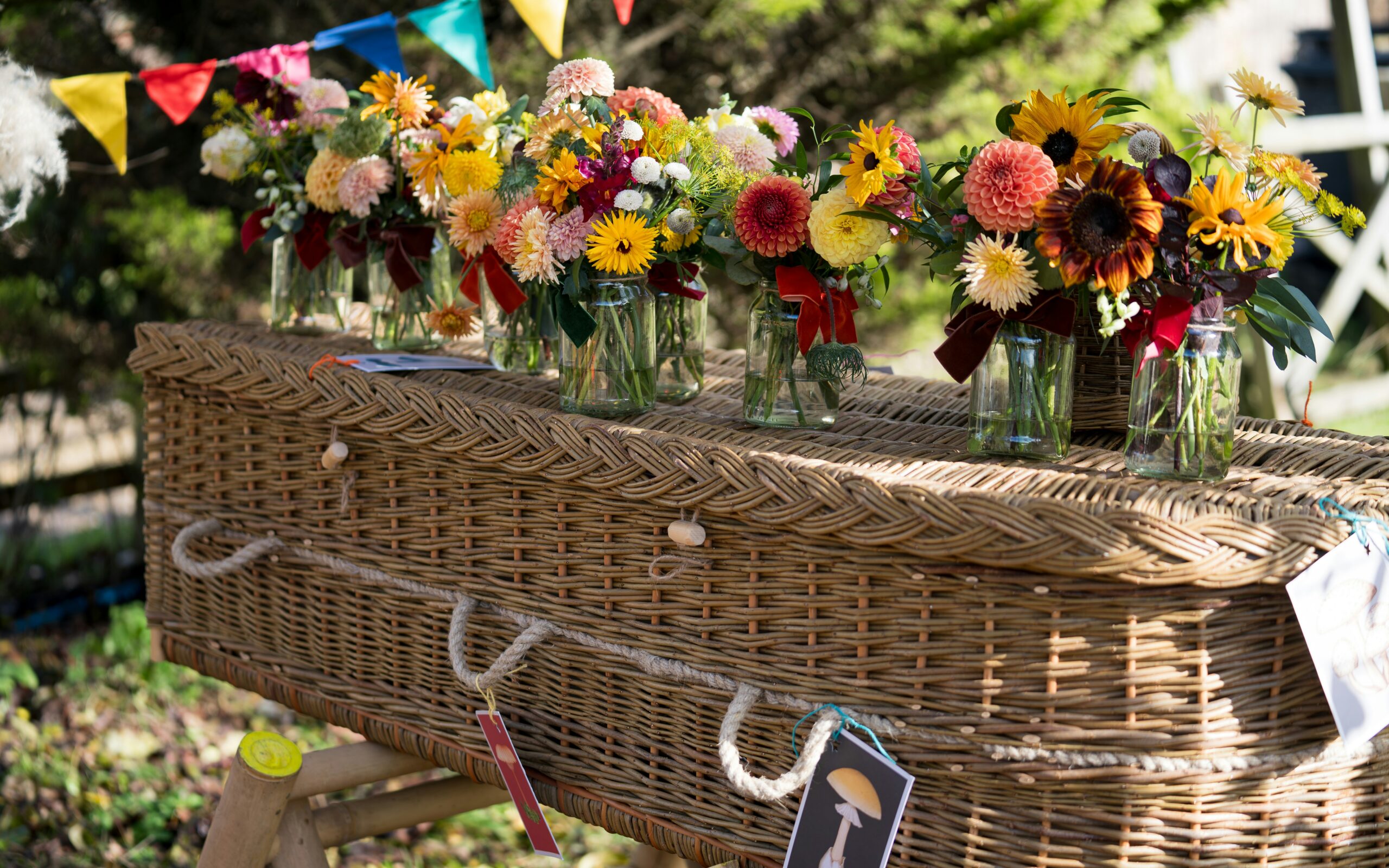
Another consideration is the materials used and the overall appearance of a coffin compared to a casket. Coffins are usually constructed from wood or metal, such as copper or steel. They are generally very plain and simple in appearance. Caskets may also be built from metal or wood, but they typically have more options for customization. Examples of customizable components on a casket include the size, interior, lid, and the details used for embellishment.
Since caskets have more customization options and tend to be more ornate, they also tend to be more expensive when compared to coffins. There are fewer materials necessary to craft a coffin, which also contributes to a lower price when compared to a casket. While coffins may be an option for those who are planning a low-cost funeral, it should be noted that finding an appropriate vendor can be challenging due to an overall decrease in popularity.
Ultimately, deciding whether to select a casket or coffin depends on personal preferences, cultural traditions, and budget considerations. Sometimes, it is a decision between simplicity or increased customization. However, one option is not more appropriate than another, and both have potential advantages and disadvantages.
Sources
“Casket vs. Coffin: Six Key Differences You Should Know”. Vaughn NC Greene.
“Caskets vs. Coffins”. Cage Memorial.
What Is a Perpetual Care Cemetery?
July 24th, 2025A perpetual care cemetery, also known as an endowed care cemetery, is a burial ground that includes ongoing upkeep and maintenance of the cemetery grounds and respective gravesites. This can include ensuring grass and landscaping are consistently maintained, signs are visible and easy to read, and broken headstones or grave markers are repaired as needed. Although selecting a perpetual care cemetery doesn’t include regular cleaning of a loved one’s gravesite, some cemeteries are willing to offer this service for an additional fee. The “perpetual care” terminology is used due to the cemetery’s established commitment to ensure that the burial grounds are maintained and taken care of in perpetuity.
Perpetual care cemeteries typically rely on proceeds that are placed into an endowment fund or trust whenever clients purchase services or plots on the site. Some cemeteries may have two separate funds: one used for general maintenance of the cemetery and the other for care of gravesites. A portion of the proceeds from services purchased are allocated toward the ongoing maintenance and care of the burial grounds to ensure that the cemetery always has enough financial resources to uphold its commitment. Once the proceeds are transferred to the fund or trust, they cannot be used until the cemetery is full and otherwise unable to generate any further income from its services.
Individuals who are interested in working with a perpetual care cemetery are encouraged to research local cemeteries in their area. While some perpetual cemeteries effectively advertise their services more openly, many cemeteries will simply list that they offer perpetual care somewhere on their website. If there isn’t any indication of whether perpetual care is offered on the cemetery site, consider contacting the cemetery directly to inquire about whether it is an option. Additionally, since the anticipated costs of working with a perpetual care cemetery can vary, making direct contact to obtain estimates for potential costs is highly recommended.
Sources
“What is Perpetual Care?” Willowbrook Cemetery.
https://willowbrookcemetery.com/blogs/blog-entries/1/Our-Blogs/2/What-is-Perpetual-Care.html
“Perpetual Care Cemetery”. Brown Memorials.
https://www.brownmemorials.com/blogs/perpetual-care-cemeteries
What Is a Companion Plot?
July 24th, 2025A companion plot is two adjacent burial plots, either side-by-side or on top of one another. Individuals selecting a companion plot can pair them with one or two headstones, depending on the chosen plot. Typically, couples or close family members purchase a companion plot to ensure they are together after death. However, companion plots may also be selected when multiple deaths occur within the same family or group on the same day.
It is essential to be mindful of the potential cost of companion plots while budgeting for final arrangements. Since you are purchasing two plots, or double the amount of space, it’s typical for the cost of a companion plot to be double that of a single plot as well. On the other hand, purchasing a single double-depth plot will typically be more affordable than the companion plot.
Other factors that can influence the cost of the plot include whether it is located in a private or public cemetery and whether the plot type depends on the remaining amount of space at the cemetery. Further, if a double-depth plot is selected but needs to be reopened and closed again due to different death dates, there may be additional fees to factor into the total cost.
People typically choose companion plots due to the meaning and intent behind the decision. A companion plot can reflect a deep bond and connection between two people that will remain even in death. It can provide a physical space where friends and family can remember two loved ones and further reflect on their shared legacy of love. Additionally, the concept often provides comfort to friends and family members who know that their loved ones are together even after death.
Sources
“The Four Types of Cemetery Plots”. EverPlans. https://www.everplans.com/articles/the-four-types-of-cemetery-plots
How Long Does a Concrete Burial Vault Last?
July 24th, 2025The longevity and durability of a concrete burial vault depend on a few factors, such as the quality of the materials used in the construction of the vault, exposure to environmental conditions, and the overall maintenance of the vault as time progresses. While there isn’t a defined lifespan for burial vaults, some vendors will specify a certain number of years that their burial vaults remain warranted or a general estimate of the average lifespan of the vault.
Concrete burial vaults are commonly recognized for their extensive durability and protection against the elements. These vaults generally last for decades, and with proper maintenance, some may even last beyond a lifetime. As with any other type of vault, however, continued exposure to environmental factors such as temperature changes and moisture can compromise the integrity of the concrete. Most vault manufacturers reinforce their concrete with additives to enhance overall durability. Additional protection may be provided by sealants and liners to reduce the likelihood of moisture and damage.
Burial vaults are an investment, and sometimes it can be difficult for families to decide which options will provide the most durability over an extensive period. Consulting with the cemetery staff when handling final arrangements can provide additional insight into the additional features and actions that are taken to maintain the integrity of the vault before burial. Ultimately, concrete burial vaults serve as a crucial component in the preservation and protection of a loved one’s final resting place. Known for the overall longevity of the materials, investing in a concrete burial vault can help provide peace of mind to families who want to ensure that their loved one remains safeguarded as time progresses.
Sources
“Burial vaults – what they are and why you need one”. Lakeside Funeral Homes.
https://www.lakesidefuneralhomega.com/burial-vaults-what-they-are-and-why-you-need-one
“What is a burial vault?” Ever Loved.
https://everloved.com/articles/funeral-planning/what-is-a-burial-vault
What Is an Oversized Casket and When Is It Necessary?
July 24th, 2025An oversized casket, also known as a large or extra-large casket, is wider or longer than a typical coffin and is necessary when the person who died is larger or taller than a regular casket can comfortably accommodate. (Anyone up to 6’5” and 350 pounds can typically fit in a standard casket). Alternatively, someone may opt for an oversized casket to include more substantial mementos with their loved one for burial. Often, oversized caskets have the same exterior dimensions found in a standard size, but the interior space is larger.
The dimensions of caskets vary slightly depending on the manufacturer, and there is no set size for an oversized casket. Typically, the interior ranges from 28 to 38 inches wide and 84 to 85 inches long (though it’s possible to purchase one up to 52 inches wide). Caskets on the upper limits of these ranges may be called double-oversized caskets. These oversized dimension ranges are significantly more substantial than a standard casket, which is typically 28 inches wide and 84 inches long. It’s important to consider that a typical burial plot is 30 inches wide and 86 inches long (longer if including space for a gravestone), so if your loved one requires an oversized casket, it’s possible you’ll need to purchase a larger plot, or even two plots, as well.
Sources
“Casket Sizes and Dimensions: What Size Casket Do I Need?” Titan Casket.
https://titancasket.com/blogs/funeral-guides-and-more/what-size-casket-coffin-do-i-need
“Are All Caskets the Same Size?” Tindall Funeral Home.
https://tindallfuneralhome.com/blogs/blog-entries/1/Our-Blogs/147/Are-All-Caskets-The-Same-Size.html
“Oversize Sensible Solution Caskets”. Starmark.
What Is the Difference Between a Full-Couch and Half-Couch Casket?
July 24th, 2025The terms “full-couch” and “half-couch” refer to casket styles that are differentiated by the lid and how the casket is used. A full-couch casket features a single lid that is hinged to open fully, allowing funeral attendees to view the entire body of the person who died. In contrast, a half-couch casket features a lid that is split into two separately hinged sections, which allows funeral attendees to view either half or the entirety of the body. The reasons for choosing these casket types can vary based on how the casket will be used.
Full-couch caskets may be selected for an open casket viewing since they provide the most visibility of the person who died during the process of paying respects. They may also be used for closed casket viewings when there isn’t any intent to display the person who died, such as when the body is not in acceptable condition for an open casket funeral. A half-couch casket may be preferable for individuals who wish to have an open casket viewing but want to maintain a sense of modesty or prefer a partial viewing for specific reasons.
It is important to note that both full and half-couch caskets are appropriate for use in burial and are available in a variety of materials and styles. Half-couch caskets will have a seam at the top due to the split design of the lid, but this is merely a visual difference and does not affect the efficacy of the lid itself. Ultimately, the choice between the two styles of caskets depends on the preferences, cultural norms, and traditions that mattered to the person who died and their loved ones.
Sources
“What is a half couch casket?” Titan Casket.
“Understanding Half Couch vs. Full Couch Caskets”. Funeral Basics. https://www.funeralbasics.org/understanding-half-couch-versus-full-couch-caskets/
What Is a Destination Funeral?
July 24th, 2025A destination funeral, also known as a destination celebration of life or a destination memorial service, is an alternative type of funeral that involves loved ones traveling to a location that was meaningful to the person who died. Loved ones typically travel with the body of the person who died to ensure that they are transported appropriately to the designated location. However, this can be expensive and is not a requirement for honoring your loved one. If transporting the body of the person who died to the destination is preferred, working with a funeral director is highly recommended for simplifying the logistics. Although many people hold destination funerals within the same country, it is becoming increasingly popular to travel abroad as well.
The goal of having a destination funeral is to provide a personalized and unique farewell or celebration of life for the person who died. Locations may be associated with meaningful milestones, connections, or interests to the person. This means that a destination funeral might involve traveling to a place of cultural significance, a favorite vacation spot, or a location that was associated with a specific hobby or achievement. In general, the location is somewhere that reminds loved ones of cherished memories or allows them to form one more special memory in honor of their loved one.
Since destination funerals are fairly specific to what was meaningful to the person who died, they usually need to be planned in advance by that individual and other loved ones who can ensure the travel is facilitated effectively. Similar to other types of funeral planning, people can make arrangements to pay for the service and the burial or cremation ahead of time so that everything is already taken care of following their death. It is important to be aware that destination funeral planning can be more extensive and complicated than conventional funeral planning due to the logistics of traveling with the body, especially if a plan had not been made prior to death. In general, it is usually easier to travel with cremated remains rather than an embalmed body due to the various licensing requirements and regulations required for transporting a body.
It’s important to take into consideration that attending a destination funeral can involve significant costs, which may limit the number of people who are able to attend. Holding a smaller, local gathering after the destination gathering may be a nice option for others who would like to gather in memory of their loved one.
Sources
“Destination Funerals on the Rise as Traditional Wakes Are on the Decline”. Yahoo News. https://uk.news.yahoo.com/destination-funerals-rise-traditional-wakes-144757556.html?
“Are you ready for a destination funeral?” iMortuary. https://www.imortuary.com/blog/are-you-ready-for-a-destination-funeral/
Can I Collect a DNA Sample From My Loved One Before the Funeral or Final Disposition Takes Place?
July 24th, 2025It is absolutely possible to collect a DNA sample from a loved one after they die. DNA can be useful if you wish to learn more about your loved one’s ancestry or locate family members who you’ve not yet met. Genetic testing can also be useful in uncovering hereditary illnesses or detecting a predisposition to certain medical conditions such as Parkinson’s disease, Type 2 diabetes, high blood pressure, atrial fibrillation, and more.
If you wish to collect DNA from your loved one, it’s best to plan ahead and order a sample kit from a company such as Ancestry, CRI Genetic,s or 23 & Me. These kits come with detailed instructions and a return envelope, so the process should be fairly easy to complete. That said, even if you did not order a kit in advance of your loved one’s death, you can still collect a DNA sample yourself and store it until you have the time and energy to send it off. To make sure you have an adequate sample, follow this procedure outlined by EasyDNA :
- Clean your loved one’s mouth using plain water. (No mouthwash, lemon/glycerine swabs or toothpaste.)
- Rub the end of a sterile cotton swab along the inside of the person’s cheek, against the gums, and inside the lips for one minute. Repeat this process with four separate cotton swabs. If you are using swabs with cotton on both ends, cut the unused cotton off.
- Allow the swab to dry for at least one hour. The best way to do this is to put the swab in a clean glass with the cotton end sticking up in the air.
- Place the swabs in a clean, dry envelope labeled with the person’s name and any other identifying information you would like to include.
- Put the envelope with the swabs in another, larger envelope for safekeeping.
- When you are ready, send the sample to the company of your choice.
Sources
Ancestry. https://www.ancestry.com/
CRI Genetic. https://www.crigenetics.com
23 & Me. https://www.23andme.com/
“How to create your own DNA test kit.” Easy DNA . https://www.easy-dna.com/resources/create-your-own-dna-kit/
What Is the Proper Way to Clothe My Loved One for Their Viewing and Burial?
July 24th, 2025There aren’t specific rules when it comes to dressing your loved one for their funeral and viewing, though many people opt for formal or conservative attire (and some religions have specific customs, which will be discussed). Generally, you can choose a viewing and/or burial outfit in keeping with the personal style of the person who died, an option which is becoming increasingly popular. If they preferred formalwear or were more casual, you can honor their preference by selecting an outfit that reflects their personality.
If your loved one was in the military, enjoyed sports, or was an outdoors or baking enthusiast, feel free to dress them in their uniform, favorite jersey, hiking clothes or apron. You can consider clothing that will spark cherished memories for viewing and funeral attendees. If there are items significant only to you or a couple of close family members or friends, you may want to include those for the burial only.
Most often, it’s preferable to dress the body with undergarments on. Shoes and socks are often left off, as the feet can become rigid and may be difficult to manipulate. Some funeral homes have preferences regarding shoes, which you can confirm with the funeral director. You can include jewelry, though if you want to keep any pieces as family heirlooms, be sure to remove them after the viewing.
If your loved one’s clothing no longer fits them due to illness or other factors, you may want to purchase new clothes. You can also speak with your funeral professional about clothing options they may have available, as many funeral homes carry a line of clothing specifically for this purpose.
Religious customs for viewing and burial attire
In some cases, religious or cultural traditions may dictate what someone should wear for their funeral. It’s important to respect and honor these traditions if your loved one wants that. For a Jewish funeral, traditional burial clothing consists of a simple shroud with no jewelry or accessories (if a prayer shawl was worn in life, the loved one can be buried in one with a fringe cut off). For Buddhists, if not cremated as is typically favored, daily clothes are preferred. In the Muslim faith, the body is most often dressed in a shroud, usually made of white cotton.
Sources
“How to dress a deceased loved one for a funeral.” Phaneuf. https://phaneuf.net/blog/how-to-dress-a-deceased-loved-one-for-a-funeral
“How do funeral homes dress bodies?” Love to Know. https://www.lovetoknow.com/life/grief-loss/how-do-funeral-homes-dress-bodies
“Diversity in Dying: Death Across Cultures.” Milne Publishing. https://milnepublishing.geneseo.edu/nursingcare/chapter/diversity-in-dying-death-across-cultures/
“Jewish burial garments”. Jewish Funeral Home. https://www.jewish-funeral-home.com/jewish-burial-garments/
What Are Appropriate Items to Place in My Loved One’s Casket? What Items Are Not Permitted?
July 24th, 2025The items that may be placed in a casket largely depend on whether your loved one will be buried or cremated. For burials, what can be placed in a casket can vary between traditional and green burials. Since green burials emphasize the importance of sustainability and eco-friendly practices, items that are not organic or biodegradable, including clothing worn by the person who died, are generally not permitted.
In contrast, many of those items would be acceptable in a casket that was intended for a traditional burial. Examples of items that you can place in your loved one’s casket prior to a traditional burial can include:
- Photos
- Flowers
- Letters
- Religious items
- Jewelry
- Keepsakes
- Stuffed animals
- Toys (without batteries)
- Blankets
- Sports items
- Memorabilia
- Musical instruments
- Military medals
- Awards
There are very few limitations regarding what can be placed in a casket prior to a traditional burial, which means that any items that were meaningful or symbolic to your loved one can typically be included. However, if the intent is to cremate your loved one, there are a few limitations to keep in mind. Generally, the following items are not permissible to place in a casket prior to cremation:
- Combustible items (explosives, fireworks)
- Electronics
- Batteries
- E-cigarettes
- Treated materials (latex, leather, chemically-treated fabrics)
- Items that may melt or harden
- Firearms
The items that you choose to place in your loved one’s casket should ideally reflect their interests, personality, values, and what was important to them. If you are uncertain whether potential items are appropriate or permissible to include in the casket prior to the cremation or burial, consult with the funeral director or crematory staff. They will be able to provide additional guidance regarding items that are compliant and may even have a few suggestions regarding other potential items that can be placed in the casket with your loved one.
Sources
“What’s usually inside a casket with the deceased’s body?” Titan Casket.
“What can you put in a coffin?” Farewill.
What Is a Mausoleum Burial?
July 24th, 2025A mausoleum is a private or public above-ground structure, typically made of granite, and a mausoleum burial offers an alternative to ground interment. Mausoleum structures can range from an above-ground burial vault just large enough to contain a single casket or cremated remains to walk-in (or vestibule) mausoleums with space for multiple bodies that mourners can enter. A garden mausoleum allows mourners to pay their respects from the outside and can range in size.
Some families have a family mausoleum on private land, while some cemeteries offer plots where private mausoleums can be constructed. In some cases, cemeteries may have public mausoleums in which you can purchase a crypt like you would a plot. This tends to be the status quo in locations at or below sea level, such as New Orleans. In a case where the person who died is particularly notable, their mausoleum may be an elaborate monument.
Regardless of the structure’s size, in a mausoleum burial, the loved one is placed into a crypt, a sealed chamber within the mausoleum that holds their casket or urn of cremated remains. The crypt is often personalized with an engraving or plaque to honor and remember the person within it. The cost of a single or companion crypt is typically several thousand dollars, while an ornate family mausoleum can range from several hundred thousand dollars to multiple millions.
Sources
“Mausoleun burial guide”. Mausoleums. https://www.mausoleums.com/mausoleum-burial-guide/
“Mausoleum Crypts | Family Mausoleums”. Mausoleums. https://www.mausoleums.com/mausoleum-crypts-family-mausoleums/
What Are the Most Common Types of Burial Vaults?
July 24th, 2025A burial vault, which is a sealed protective container for a coffin, is most commonly made of concrete, though they can also be made of metal, fiberglass, or durable plastic. Their primary purpose is to protect the casket against the elements and prevent ground sinkage, and many cemeteries require them. An urn vault serves the same purpose when cremated remains are to be buried.
With its lining and seal, a burial vault is more robust than a burial liner (or grave liner). Though also generally made of concrete, a burial liner serves mainly to prevent ground sinkage above the grave. It is unlined on the inside, and may feature holes in the base to allow groundwater to drain or have no base at all. A lined burial vault offers the greatest level of protection for the coffin and has a coated exterior and lined interior.
There are different types of seals for burial vaults as well. The top seal method features a seal between the walls and lid of the vault, while the air seal method — said to be more secure — creates a pressurized seal using air pressure. Burial vaults can range in their protection level and ornateness, and their price ranges from several hundred to several thousand dollars.
For green burial, burial vaults are generally not required or even prohibited.
Sources
“What is a burial vault?” Bradshaw Funeral. https://www.bradshawfuneral.com/blog-posts/7709/what-is-a-burial-vault
“Burial Packages”. The Chapel of Peace. https://www.thechapelofpeace.com/what-are-burial-vaults-and-graveliners/
Can I Request to Have My Loved One’s Clothes Returned After the Viewing or Funeral?
July 24th, 2025Although clothing is typically not returned to the family after a viewing or funeral, this request can usually be honored if the funeral director and staff are informed beforehand. Providing early notification to the funeral director regarding this request is necessary since the clothing would otherwise be cut for ease of dressing the person who died during the preparation for the viewing or funeral. If you request to have the clothing returned after the funeral or viewing, the clothing will remain intact.
Since your loved one’s clothing will not be cut for the dressing process if you request that the clothing be returned to you, there are a few considerations to keep in mind when selecting clothing for your loved one to wear. The general recommendation is to select clothing that is one to two sizes larger than the person’s usual size and with long sleeves. After death, the shape of the body tends to change as time continues to pass. Larger clothing sizes will accommodate these changes and make the dressing process easier.
Choosing to have the clothes returned to you often means that your loved one may be buried or cremated in a funeral gown or similar garment. This is one reason why it remains standard practice for a loved one to be buried or cremated in the same clothes that they were wearing during the viewing or funeral. Additionally, while the funeral home staff will wash your loved one’s clothing before it is returned to you, it will likely be washed in the same machine used for other soiled items used by the staff during body preparation.
Asking to have a loved one’s clothes returned after the viewing or funeral is a matter of personal preference. While it is not a common request, it is important to note that it is not an inappropriate request to make. Individuals who are interested in exploring this option are encouraged to consult with their funeral director for additional guidance regarding garment sizing and the timeline for receiving the returned clothing.
Sources
“Choosing Clothing Guidelines”. Lakeshore Funeral Home.
https://www.lakeshorefuneralhome.com/choosing-clothing-guidelines-2