

Alternatives to Burial & Cremation
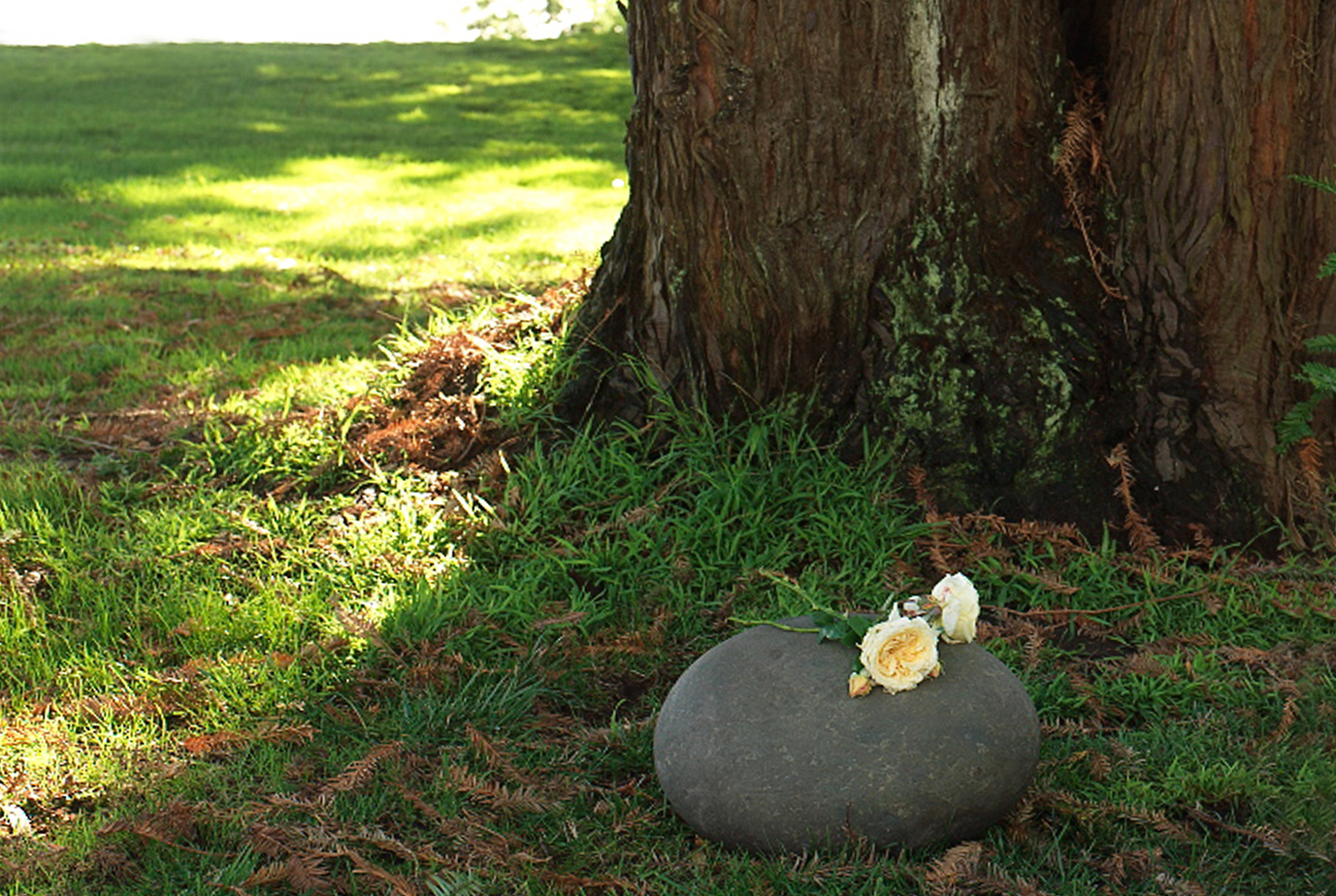
More people are exploring alternatives to traditional burial and cremation. Options that reflect personal values, environmental concerns, or a desire for something unique. This section introduces a range of choices, including alkaline hydrolysis, human composting, body donation, burial at sea, and more. Whether you’re planning ahead or just curious, these articles offer thoughtful insights to help you understand what’s possible and find the option that feels right for you.
Jump ahead to these answers:
- What Are Alternatives to Burial and Cremation?
- What Does Human Composting Cost?
- Is Alkaline Hydrolysis Legal in Every State?
- What Is Cryonics?
- What Is the Process of Promession?
- What Is Entombment? How Does It Differ From Burial?
- What Is a Tree Pod Burial?
- What Is the “Body Worlds” Exhibit?
- What Is the Process Involved in Plastination?
- What States Currently Allow Human Composting?
- Do Bones and Teeth Decompose During the Human Composting Process?
- Can Families Participate in the Composting Process or Ceremony?
- Is Human Composting Safe for the Environment?
- What Is the Process for Arranging a Full-Body Sea Burial?
- Does a Body Need to Be Embalmed for a Burial at Sea?
- What Happens to a Body When Buried at Sea?
- Are There Private Companies That Provide Full-Body Burial at Sea?
- My Loved One Was a Veteran. Will the Navy Conduct a Burial at Sea?
- What Is Open-Air Cremation and Is It Harmful to the Environment?
- What Happens to My Body When I Donate It to Science?
- Has Cryonics Ever Revived Anyone?
- What Is the Cost of Cryonics?
- Why Would Only a Person’s Brain Be Cryonically Preserved?
- Why is Alkaline Hydrolysis Called Green Cremation?
- Is Alkaline Hydrolysis More Eco-Friendly Than Cremation or Burial?
- How Much Does Alkaline Hydrolysis Cost?
- How Is the Liquid Portion of a Person’s Remains Disposed of After Alkaline Hydrolysis?
- Lesser Used Disposition Options
- Alternatives to Burial & Cremation Additional Resources
What Are Alternatives to Burial and Cremation?
July 9th, 2025
Today, more and more people are searching for funeral alternatives to traditional burial and cremation. Driven by concerns about the environment as well as more personal motives, they are seeking out innovative methods to dispose of their bodies after they die. From green burials to human composting to alkaline hydrolysis and burials at sea, novel methods of final disposition are cropping up all across North America. And while some of them aren’t yet widely available, the death care industry is taking notice of these shifting attitudes and slowly beginning to offer some of these funeral alternatives to consumers.
At SevenPonds, we have noticed that people often confuse what to do with cremation ashes as a disposition method. Cremation is the disposition method, and what to do with cremation ashes is one of the many ways to lay cremation ashes to rest. We wanted our readers to be clear when we present the 9 alternative disposition methods (either viable or theoretical) to conventional burial and cremation are as follows.
Jump ahead to:
- Alternative No. 1 Green or Natural Burial
- Alternative No. 2. Open-Air Funeral Pyre
- Alternative No. 3. Alkaline Hydrolysis or Aquamation
- Alternative No. 4 Burial at Sea
- Alternative No. 5 Cryonic Preservation
- Alternative No. 6. Whole-Body Donation
- Alternative No. 7. Natural Organic Reduction
- Alternative No. 8. Plastination
- Alternative No. 9. Promession
- Why Choose Funeral Alternatives to Burial and Cremation?
Alternative No. 1. Green or Natural Burial
One of the most well-established alternatives to conventional burial and cremation, a green burial or natural burial forgoes the usual trappings of modern body preparation and burial. Bodies buried in a green cemetery are not embalmed and are buried in a shallower grave than they would be in a more traditional cemetery (3 to 4 feet versus 6 feet), without a concrete vault or liner. Caskets, if they are used, are made of biodegradable materials such as wicker, cardboard or unadorned soft wood. In many cases, the body is simply wrapped in a cotton shroud. Additionally, most natural burial grounds don’t permit headstones. The location of the grave may be marked with a rock or tree, or simply noted using GPS coordinates.
At this time, it’s unclear whether natural burial is truly “greener” than burial in a “traditional” cemetery. Although it seems logical that burying tons of concrete, embalming fluid and other chemicals in the ground is bad for the environment, the benefits of avoiding these trappings of the typical American funeral have not been proven scientifically. Nonetheless, the idea of returning to the earth in a more natural state appeals to many consumers today. To learn more about this method of disposition available across the US, visit our section on green burial.
Alternative No. 2. Open-Air Funeral Pyre
Open-air cremations are cremations performed outdoors over an open fire known as a pyre. They are popular in some parts of the world, most notably India, but at this time, the only open-to-the-public open-air funeral pyre in the U.S. is located at the Crestone End-of-Life Project in Crestone, Colorado. Run by the nonprofit Informed Final Choices, the project offers open-air cremations only to residents of Crestone and Saguache counties.
People who have witnessed CEOLP’s outdoor cremations call the experience “transformative,” said Stephanie Gaines, the current director of CEOLP and IFC. Stephanie spoke with SevenPonds about the Crestone End-of-Life Project several years ago. If you’d like to read the complete interview, you can find it in the Professional Advice Column in our magazine.
Alternative No. 3. Alkaline Hydrolysis or Aquamation
Also known as biocremation(™), resomation(™), flameless cremation, green cremation, water cremation, and aquamation, alkaline hydrolysis is a process that uses heated water and an alkaline substance (typically sodium hydroxide or lye) to dissolve a body after death. A widely accepted method of disposing of animal carcasses for years, alkaline hydrolysis (AH) was first used to dispose of human remains that had been donated for medical research at the Mayo Clinic in Rochester, Minnesota, in 2006.
The process and equipment used for alkaline hydrolysis vary somewhat, but are essentially the same:
- After a number of hours in a specially designed chamber, the person’s body is reduced to bones and a sterile liquid about the consistency of motor oil.
- The liquid is then drained and either saved for the family or discarded. According to Texas A&M University, this “effluent” contains no DNA and is free of “all pathogens [disease-causing microorganisms], including the protein coats of viruses, the peptide bonds of prions and vegetative and spore-forming bacteria.”
- Any residual metal (orthopedic hardware, defibrillators, pacemakers) is removed using a magnet. The bones are pulverized as they are in fire-cremation and returned to the family as “ash.”
In some cases, the liquid portion of the remains (known as effluent) is disposed of in municipal wastewater. However, some facilities allow loved ones to take the liquid home, where it can be scattered in a garden along with the ashes, or used in some other way.
Alternative No. 4. Burial at Sea
Sea burial is a form of final disposition in which the remains of a person who died are taken out on a vessel and deposited in the ocean. Typically, the body is either buried in a casket with holes drilled in the side, or wrapped in a biodegradable, weighted shroud to ensure that it sinks as quickly as possible to the ocean floor.
There are a number of companies on both coasts of the United States that provide full-body burials at sea. However, if you have access to a vessel and a skilled crew, you can also conduct a burial at sea yourself. Additionally, the U.S. Navy will assist current and former service members with sea burial, although the process takes quite a while.
The U.S. Environmental Protection Agency regulates sea burials and monitors at-sea disposal of human remains. As a rule, the agency does not require a special permit. The disposition of human remains in ocean waters is covered under a general permit authorized under the Marine Protection, Research and Sanctuaries Act. You must, however, report the burial to the EPA within 30 days.
To learn more about conducting a burial at sea, visit this EPA web page, which outlines the rules around ocean burials and offers tips to help ensure that your experience is a success.
Alternative No. 5 Cryonic Preservation
Cryonics is the process of freezing and preserving a person’s body immediately after legal death with the eventual goal of restoring full function at some time in the future. According to Ben Best’s The History of Cryonics, the concept was introduced in the early part of the 20th century by Robert Ettinger, a physics teacher and long-time science fiction buff. In 1962, Ettinger wrote “The Prospect of Immortality,” which described his theory in detail. However, the book wasn’t published until 1964, when the famous author/scientist Isaac Asimov convinced Doubleday that the concept of cryonics was scientifically sound.
According to Best, the first person in the United States to be cryogenically preserved was Dr. James Bedford, whose body was maintained at the Cryonics Society of California from Jan. 12, 1967, until his body was transferred to Alcor Technologies in 1982. Of the 17 people who were cryopreserved between 1967 and 1973, Bedford is the only one who is still cryogenically preserved. To date no cryonically preserved body has been brought back to life.
At this time, two companies in the United States offer cryonic preservation: Alcor Life Extension Foundation in Scottsdale, Arizona, and Cryonics Institute in Clinton Township, Michigan. Both companies are active and available to answer questions or accept new members.
Alternative No. 6. Whole-Body Donation
Choosing to donate your body for medical research is a noble decision, and there are dozens of medical schools across the country that can help facilitate that wish. The Anatomical Board of the State of Florida has compiled a comprehensive list of these programs that includes the address of the facility and the phone numbers to call. Contact the program nearest you to get more information and enroll.
Although most people are eligible to donate their bodies, some conditions will preclude your acceptance at the time of your death. According to the University of California at Davis, these include (but are not limited to) the following:
- Hepatitis B or C
- HIV/AIDS
- Tuberculosis
- Kuru
- Creutzfeldt-Jakob’s disease
- MRSA/VRSA (methicillin-resistant and vancomycin-resistant Staphylococcus aureus)
- Recent extensive surgery
- Severe trauma
- Obesity
- Severe muscle atrophy
Bodies that have been autopsied or embalmed are generally ineligible as well. Additionally, if the facility you have chosen has a sufficient supply of bodies at the time you or your loved one dies, it may reject the donation despite there being no obvious issues that would preclude its use. In this case, your loved ones may be able to donate your tissues through a local organ procurement organization or a company such as MedCure or Science Care, which coordinates with medical researchers nationwide. However, they, too, may not accept the donation for a variety of reasons, so it’s a good idea to have a backup plan (such as an inexpensive direct cremation) in place.
Alternative No. 7. Natural Organic Reduction
Sometimes referred to as “human composting,” natural organic reduction is a new form of final disposition developed by a team of scientists led by Katrina Spade, the CEO of the public benefit corporation Recompose. The process is similar to what occurs on the forest floor as organic material decomposes and becomes topsoil. However, unlike natural decomposition in a forest, human composting happens inside of a vessel and is carefully monitored by certified professionals.
At the Recompose facility near Seattle, Washington, this transformation into soil takes place in specially designed hexagonal vessels lined with high-carbon materials such as wood chips and straw. After the body is placed in the vessel, the vessel is aerated to create an environment conducive to rapid natural decomposition. Heat is created by microbial activity – these high temperatures kill harmful pathogens and ensure a final resulting material that is safe for use on plants and trees. The entire process takes about 8-12 weeks.
Each body creates about a cubic yard of soil. The nutrient-rich soil is ready to grow new life and returns nutrients from our bodies to the natural world. Human composting sequesters carbon and can nourish new life in gardens, forests, and on conserved lands.
(See image below.)
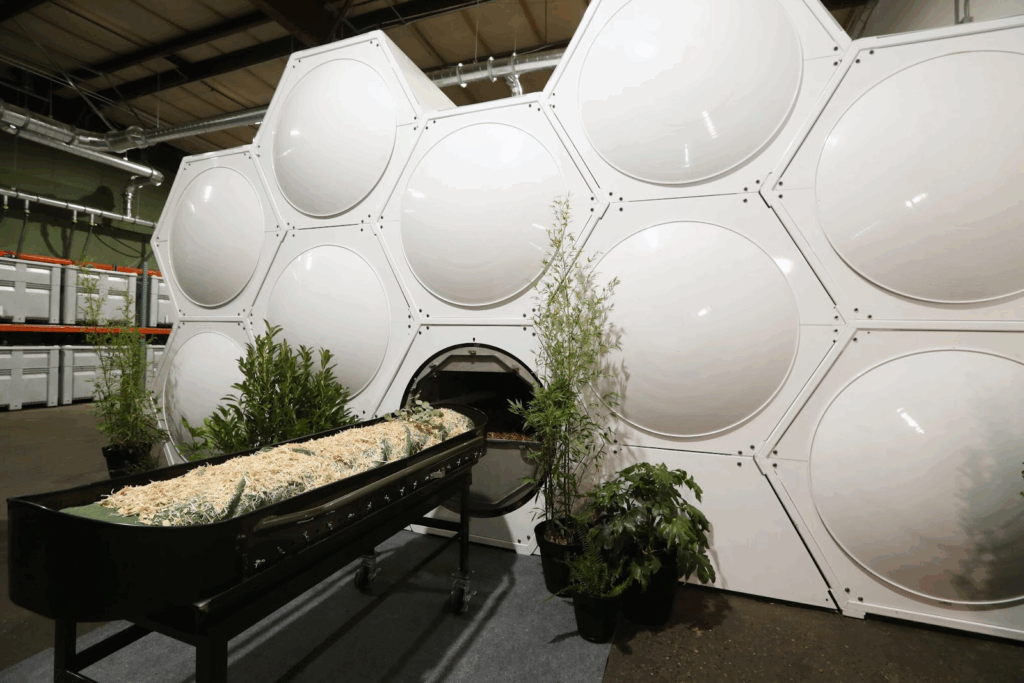
Recompose facility in Kent, Washington
Since Spade first introduced the concept of natural organic reduction, a number of other companies have begun to offer the option as well. Two of the more well-established in the U.S. are Earth, which calls its process “soil transformation” and offers services in Arizona, California, Nevada, New Mexico, Oregon and Washington, and Return Home, a Washington based company that offers the process, which it calls “terramation” to families across the continental United States.
Alternative No. 8. Plastination
Developed in 1977 by Dr. Gunther Von Hagens at the University of Heidelberg in Germany, plastination is a method of body preservation that involves extracting all bodily fluids and soluble fat from a cadaver and then using “vacuum-forced impregnation” to infuse the cells with a liquid polymer such as epoxy resin, polyester or silicone. It is a time-consuming, expensive, multi-step process that involves dissection of the body and subsequent repositioning of the plastinized tissues, followed by an extended period of “curing” or hardening. The finished products are unique, life-like specimens that are used for medical education and research or placed on display in one of several Body World exhibitions across Europe, Canada and the U.S.
Currently, plastination of human remains is performed on donated bodies in over 400 facilities worldwide. The body donation program is administered by the Institute for Plastination in Heidelberg, Germany, which has a roster of almost 20,000 body donors as of June 2019.
Alternative No. 9. Promession
Developed by a soil scientist Susanne Wiigh-Mäsak in 1997, promession is a form of final disposition that proposes to use liquid nitrogen and mechanical vibration to freeze the body and then turn it into fine particles much smaller than cremation ash. The concept has been widely adopted by a number of advocacy groups across the globe; however, it has not yet been used to dispose of human remains. The company founded by Wiigh-Mäsak, Promessa, went bankrupt in 2015 without ever building a promession facility, and Wiigh-Mäsak died from cancer in 2020, so it is unlikely that promession will be available in the near future.
Why Choose Funeral Alternatives to Burial and Cremation?
As people across the globe become more attuned to the harmful effects of human activity on the environment and the planet, they are seeking more sustainable ways to live their lives. Insofar as everyone living will eventually die, many forward-thinking individuals are beginning to explore innovative ways to dispose of the dead in more environmentally friendly ways. And while none of the methods mentioned above is perfect from an environmental standpoint, each of them offers substantial benefits over traditional burial and flame-based cremation.
Sources
“Why conventional burial harms the environment”. Milton Fields. https://miltonfieldsgeorgia.com/conventional-burial-harms-environment/
“Volunteer Locally”. HRSA. https://www.organdonor.gov/get-involved/volunteer
“MPRSA General Permits”. United States Environmental Protection Agency. https://www.epa.gov/marine-protection-permitting/mprsa-general-permits
“The Real Environmental Impact of Cremation”. American Cemetery & Cremation. https://www.kates-boylston.com/american-cemetery-and-cremation/the-real-environmental-impact-of-cremation/article_8dab7b60-406f-11ee-9b6b-e7b6ddd4dd6d.html#:~:text=According%20to%20the%20Natural%20Death,mercury%20vapor%20and%20other%20pollutants.
What Does Human Composting Cost?
July 7th, 2025Human composting can cost up to several thousand dollars, depending on a few factors. These factors include the process used for composting, the location of the facility, and additional services offered by the facility. For example, some facilities include different pricing tiers and packages based on the level of service requested, such as receiving a portion of the composted remains or including a memorial ceremony prior to the composting process.
Although human composting is frequently believed to be cheaper than traditional burial, it is typically more expensive than a simple or “direct” cremation. In 2021, the median cost of a funeral with cremation was $6,970 and the median cost of a funeral with viewing and burial was $7,848 (excluding a burial plot and perpetual care of the grave site which typically runs in the thousands of dollars). In comparison, human composting at Recompose costs $7,000.
As mentioned, costs can vary based on the process used. Return Home in Auburn, Washington, uses a human composting process known as terramation, which it offers for $4,950. Comparably, a facility known as Earth, based in Auburn and Nevada offers a human composting process called soil transformation for $5,000 to $6,000. Each of these facilities also offers additional services to further customize how loved ones are remembered and honored. It’s recommended to research each company’s actual costs carefully, however, as sometimes the stated costs do not include everything.
Since human composting is not yet legal across all states, it is likely that the cost of these services will eventually become more standardized as human composting gains recognition and acceptance. The industry is still actively developing, which also likely contributes to some of the variation in projected costs. Individuals who are interested in pursuing human composting for themselves or a loved one are encouraged to research and contact facilities that provide this service to gain more insight into the specific processes, service options, and associated costs in their area.
Sources
“How does the cost of human composting compare to other options?” Recompose. https://recompose.life/faqs/how-does-the-cost-of-human-composting-compare-to-other-options/
“Human Composting Can Actually Be More Affordable Than a Traditional Burial — Here’s the Price Breakdown”. Green Matters. https://www.greenmatters.com/sustainable-living/how-much-is-human-composting
“Return Home: Human Composting”. https://returnhome.com/
“Earth.” Retrieved from https://earthfuneral.com/
Is Alkaline Hydrolysis Legal in Every State?
July 7th, 2025According to the map supplied by the Cremation Association of North America, shown below, alkaline hydrolysis of human remains is currently legal in 19 states.
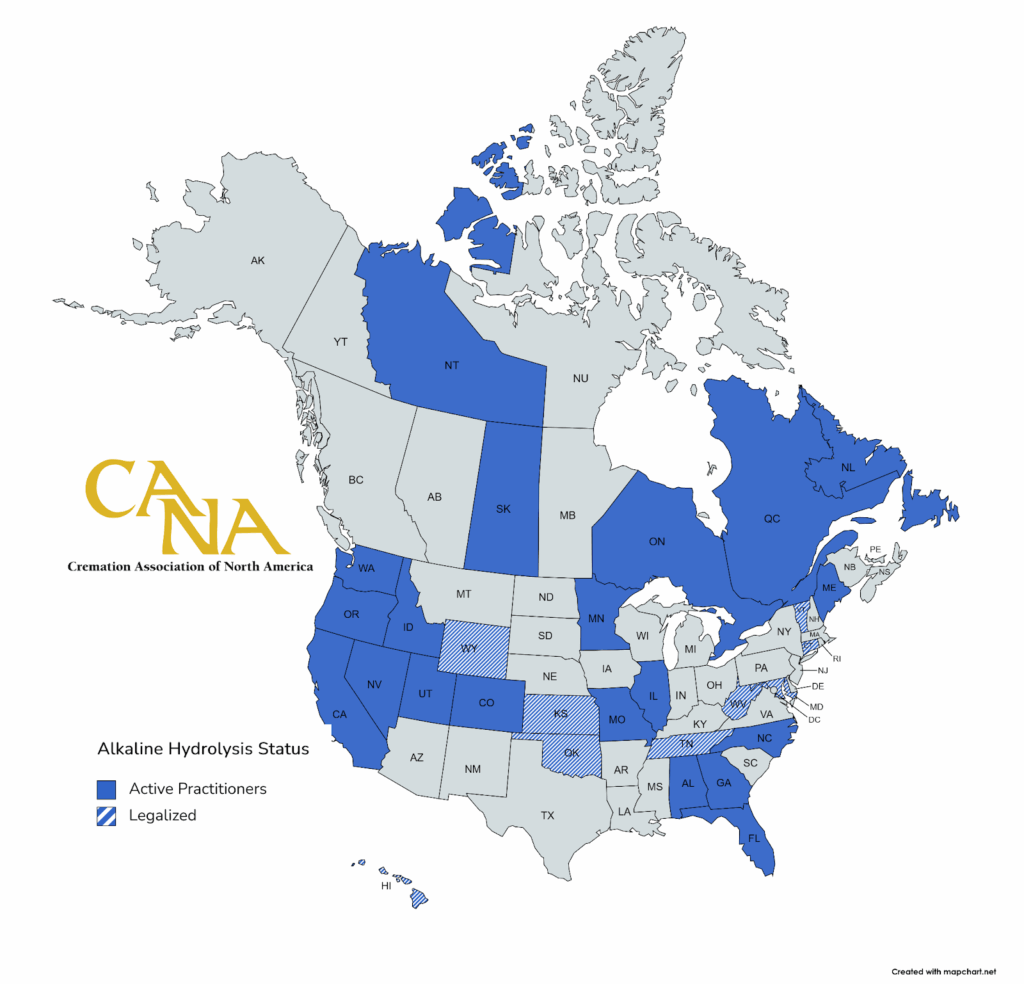
They include:
- Alabama
- California
- Colorado
- Florida
- Georgia
- Idaho
- Illinois
- Kansas
- Maine
- Maryland
- Minnesota
- Missouri
- Nevada
- North Carolina
- Oregon
- Utah
- Washington
- Wyoming
However, in many cases, it was made legal by changing the definition of cremation rather than by legalizing the process itself. According to Barbara Kemmis, the Executive Director of the Cremation Association of North America, these states broadened the meaning of cremation to include any “mechanical or thermal or other dissolution process that reduces human remains to bone fragments,” in order to allow alkaline hydrolysis to occur legally there. CANA also adopted that definition in 2013.
With that being said, CANA estimates that 1% of all cremations in North America are carried out through alkaline hydrolysis. And, according to a 2019 survey conducted by the National Funeral Directors Association, only 7.5% of those who responded were aware of alkaline hydrolysis. This could be a reflection of several issues:
- Alkaline hydrolysis is not widely available. As of this writing, facilities are available in only 15 states.
- Religious objections. A number of religious leaders have voiced objections to alkaline hydrolysis. For example, in 2008, the Catholic Conference of Ohio was successful in helping to defeat an effort to legalize the practice, saying, “Dissolving bodies in a vat of chemicals and pouring the resultant liquid down the drain is not a respectful way to dispose of human remains.” However, other Catholic leaders have deemed the practice “morally neutral.”
- The “ick” factor. Many people simply find the idea of dissolving a body in a vat of lye aesthetically repugnant. This is an issue of public perception, of course, and may dissipate with time. At one time, the public reacted the same way to the idea of FIRE CREMATION, which is now the most popular form of FINAL DISPOSITION in the U.S.
Sources
“What do you know about alkaline hydrolysis?” Cremation Association of North America. https://www.cremationassociation.org/blogpost/776820/313847/What-do-you-know-about-Alkaline-Hydrolysis?hhSearchTerms=%22alkaline+and+hydrolysis%22&terms=
What Is Cryonics?
July 7th, 2025According to Alcor Life Extension Institute, the process of cryopreserving a human body is quite complex. It is best understood as a series of three distinct steps.
- Step one is preservation of organ function, particularly that of the brain. Alcor accomplishes this by placing the newly deceased body in ice water and employing a heart-lung resuscitator (HLR) — a device known as a “thumper” — which hospitals use to perform CPR. The HLR keeps oxygenated blood circulating throughout the body until the person can be cryopreserved. During this period, Alcor personnel also administer intravenous medications to maintain blood pressure and minimize oxidative stress. These may include an anesthetic as well as anticoagulants, vasopressors, pH buffers and chemicals to minimize the formation of free radicals.
- Step two is the administration of a cryopreservative solution. This solution contains chemicals that prevent tissues from freezing when they are cooled. Instead, they undergo vitrification, which preserves the structure of the cells by preventing the formation of ice. Doctors administer the solution through several major blood vessels to ensure that it is distributed evenly.
It’s important to note, however, that these two steps are only possible if the person is located in a hospice or hospital close to Alcor at the time of death. If death occurs outside the Scottsdale area, a “standby team” is dispatched to the person’s location before death. Alcor contracts with two contractors, Suspended Animation, Inc., and International Cryomedicine Experts, Inc., whose teams begin the process of stabilization in the field. In that case, instead of putting the body in ice water, a member of the team attaches the patient to an HLR, which rapidly cools the blood and then replaces it with an organ preservation solution at a temperature a few degrees above freezing. If there will be a long delay before the body arrives at an Alcor facility, the team may employ a process known as field cryoprotection, which involves infusing a cryoprotectant solution to prevent tissues from freezing and transporting the body to the Alcor facility on dry ice.
- Step three occurs at the Alcor facility, where the body is cooled in liquid nitrogen to a final temperature of minus 196 degrees Centigrade over a period of two weeks. The body is housed in a stainless steel container and maintained at this temperature indefinitely.
Note: Cryonics Institute does not contract with a standby service on members’ behalf. However, they encourage members to contact Suspended Animation, Inc. and make arrangements with them on their own. Otherwise, the deceased must be transported to the CI facility and first prepared for transport by a funeral home. The cost of the funeral home and transportation to Michigan (usually by air) is the responsibility of the member or their next of kin.
Sources
“Introduction to Alcor Procedures”. Alcor Life Extension Foundation. http://www.alcor.org/procedures.html
“Vitrification.” Alcor Life Extension Foundation. http://www.alcor.org/Library/html/vitrification.html
“Who We Are”. Suspended Animation, Inc. https://suspendedanimationlabs.com/who-we-are/
International Cryomedicine Experts. https://www.cryomedics.org/
What Is the Process of Promession?
July 7th, 2025The process of promession, a funerary concept that involves freeze-drying the body of the person who died, typically involves several steps. Like cremation, the body will be reduced to powder and placed in the appropriate container of choice. The remains of the person who died can either be buried or placed into a biodegradable urn for a display or memorial. The interest in promession is increasing as more people are seeking alternative, eco-friendly practices that minimize the environmental impact of traditional cremation and burial.
The process of promession begins by placing the body of the person who died into a cryogenic freezing chamber. Liquid nitrogen that has been chilled to the temperature of -196 Celsius is sprayed on the body to achieve crystallization. After the body is completely frozen, the cryogenic freezing chamber begins to vibrate for several minutes, which causes the crystallized cells to disintegrate into small particles. These particles are collected for the next step of the process.
Particles are transferred to a vacuum chamber, which removes any remaining water or moisture by using sublimation to transform the frozen particles into vapor. This process results in the creation of powder remains that are equivalent to 30 percent of the original weight of the person who died. Metals such as tooth fillings, pacemakers, and other implants are removed from the powder by using a sieve or magnet. The remains are then transferred to a biodegradable container and sealed. This container can be buried under layers of soil, which will eventually decompose the remains over the next 6 to 18 months. Although burial is a common practice following promession, loved ones can also choose to keep the remains in an urn or transform them into a keepsake.
At this time, promession is not a widespread practice and is often subject to regulations in various regions since it requires specialized equipment and lesser-known methods of storing remains. Additionally, while promession has been performed on animals such as pigs, it has not been performed on humans and is not yet available to the public. If it were available, cultural and religious or spiritual beliefs would likely influence whether promession would be an acceptable practice. Ultimately, introducing promession will most likely require additional discussion, advocacy, and exploration among funeral professionals and the clients they serve before it can become a commonplace option.
Sources
“Alternative ways of dealing with the body of a loved one after death”. Peacefully. https://guide.peacefully.com/resources/alternative-ways-of-dealing-with-the-body-of-a-loved-one-after-death?rq=promession
What Is Entombment? How Does It Differ From Burial?
July 7th, 2025Entombment is the act of placing a person’s dead body, generally within a casket, inside a sealed structure known as a tomb, while in a conventional burial, the casket is placed in a grave dug into the earth. A sealed tomb structure provides protection from the elements and helps preserve the body for an extended period of time. The tomb may stand alone but is usually in a building containing several tombs, such as a mausoleum (above ground) or crypt (underground, often found beneath churches), and each individual interment space is known as a niche. A building containing niches for cremation urns is called a columbarium.
The practice of placing the dead inside of tombs has occurred for over 5,000 years, and was often reserved for royalty or influential individuals, as in the pyramids of ancient Egypt. Entombment is still in practice today, though is typically considerably more expensive than a traditional burial.
Sources
“What is the difference between burial and entombment?” US Urns. https://www.usurnsonline.com/burial/what-is-the-difference-between-burial-and-entombment/
“Columbarium”. Brittanica. https://www.britannica.com/topic/columbarium
“Tomb”. World History Encyclopedia. https://www.worldhistory.org/tomb/
What Is a Tree Pod Burial?
July 7th, 2025The tree pod burial is an eco-friendly alternative to traditional burial methods. It involves placing the remains of a loved one in a biodegradable pod that will be buried beneath an existing tree or a newly planted tree. The general purpose of choosing a tree pod burial is to create an environmentally sustainable, living memorial that contributes to nature’s life cycle while reducing carbon emissions. Tree pods are intended for use with cremated remains or an unembalmed body, although it should be noted that the latter option remains conceptual and isn’t available at this time..
Since tree pods are made of biodegradable material, the pods will break down over time and allow the bacteria in the soil to gradually transform the remains into a fertilizer that will stimulate the growth of the tree planted above. In most instances, tree pods are suitable for use in green cemeteries, but some individuals have also had success using them for burials on private property. Tree pods can effectively be used with cremated remains, although cremation is not typically an eco-friendly choice for those aiming to be mindful of sustainable practices. Additionally, cremation introduces a step that might otherwise be avoided by simply burying the body instead, so it’s a slightly less convenient option.
The ideal tree pod intended for use in burying an unembalmed body has yet to be created and remains a concept. The most well-known tree pod burial option emerged from the Capsula Mundi project, which offered egg-shaped pods. Although egg-shaped pods work well for cremated remains, they are far less feasible for use with bodies since it would be fairly impossible to conform the body into a fetal position to fit into the pod after death. Some organizations have proposed other versions of tree pods that address this issue, but none have been made available to date.
Sources
“Tree Pod Burial: How It Works in 2023 (Costs, Locations, & More)”. 8 Billion Trees. https://8billiontrees.com/eco-friendly-natural-products/tree-pod-burial/
“Tree Pod Burial Explained: Becoming a Tree After Death.” Earth. https://earthfuneral.com/resources/tree-pod-burial-explained/
“These Biodegradable Burial Pods Will Turn You Into a Tree”. Green Matters. https://www.greenmatters.com/p/tree-pod-burials
What Is the “Body Worlds” Exhibit?
July 7th, 2025Body Worlds is a traveling exhibition that showcases human bodies and other anatomical specimens that have been preserved through a process called plastination. The exhibit has traveled throughout the world, and some cities also have permanent exhibits available. The purpose of the exhibit is to inform visitors about anatomy, health and physiology through the viewing of the human body. Each exhibit features real human specimens, which include organ configurations, individual organs, translucent slices of the body, and presentations of the whole body.
Body Worlds has been traveling since 1995 and has been showcased in 154 cities around the world. One of the most recent exhibits from Body Worlds is “The Anatomy of Happiness”, which explores how people define happiness and the effects that the experience of happiness has on the body and mind. The lack of happiness and its detrimental implications for the body are also examined in greater detail through showcasing the damaging effects of alcohol, tobacco, and disease. The use of plastination allows visitors to see the human body and the effects of these factors on the body in a manner that would not normally be accessible. While demonstrating the overall intricacy of anatomy, it also helps visitors to see the impact of their lifestyle behaviors and choices on their bodies.
Since its introduction in 1995, the Body Worlds exhibit has been a source of fascination and controversy for many individuals. Many people have a curiosity about death and the human body, so the exhibit is one way of gaining more insight into the complexities of both. Those who support the exhibit often cite its educational value to the greater public. However, some have shared ethical concerns surrounding how bodies were sourced and whether the exhibit is a form of exploitation. Despite these differences in opinion, Body Worlds has proven to be an ongoing success around the world.
Sources
“Reconsidering Body Worlds: why do we still flock to exhibits of dead human beings?” The Conversation. https://theconversation.com/reconsidering-body-worlds-why-do-we-still-flock-to-exhibits-of-dead-human-beings-57024
“A new exhibit featuring preserved human bodies is making its North American debut in Boston”. Boston. https://www.boston.com/things-to-do/events/body-worlds-boston-exhibit/
“Body Worlds: Questions & Answers”. Body Worlds. https://bodyworlds.com/about/faq/
“The impact of Body Worlds on adult visitors’ knowledge on human anatomy: A preliminary study”. PubMed. https://pubmed.ncbi.nlm.nih.gov/26789643/
What Is the Process Involved in Plastination?
July 7th, 2025Plastination is a process that preserves biological tissue, including human bodies, using polymers. It comprises six steps: fixation, dissection, dehydration, forced impregnation, positioning and curing. However, terms for these steps may vary somewhat, such as on the Body Worlds exhibit website. German anatomist Dr. Gunther von Hagens developed the plastination process in 1977. It preserves the body with as much detail as possible for educational and instructional purposes. The six steps can take over a year to complete to achieve a plastinate that lacks odor and will not decay.
The first step of plastination is known as fixation, which is embalming. Formaldehyde or another preservation solution is injected into the arteries of the specimen to prevent any potential tissue decomposition. This step takes around four hours to prepare but ultimately requires one year to complete.
The next step is dissection, which is time-consuming given the amount of detail that remains in finished plastinates on display. Fatty and connective tissue is removed along with skin to achieve anatomical structures that will be dehydrated. This step takes at least 500 hours of labor and can extend up to 1000 hours.
The third step, dehydration, removes all of the fluids from the body. This is achieved by placing the specimens in an acetone bath so that water and soluble fats are dissolved and replaced by acetone, which will later be replaced by polymers. The entire step of dehydration takes around four months to complete.
In the fourth step of the process, known as forced impregnation, the specimen is submerged in liquid polymer and put into a vacuum. Polymers may be composed of polyester, epoxy resin, or silicone. Placing the specimen in the vacuum forces the acetone to vaporize, and the specimen absorbs the polymer instead. This step takes approximately two months.
After forced impregnation, the specimen is still flexible and can be positioned during step five. During this step, the sample will be moved and arranged with needles, wires, clamps, foam blocks, and other materials to ensure that it is positioned in a manner that properly showcases the anatomical structure. Correctly positioning the specimen is crucial, so this process typically takes around 60 to 90 days.
The final step is curing, which hardens the specimen into a plastinate. Heat, light, or gas may be used during this step to harden the polymers used in step four during forced impregnation. The final result transforms the specimen into a plastinate that will not decompose and is ready for display.
Sources
“The Plastination Process”. Anatomic Excellence. https://anatomicexcellence.com/about-plastination/plastination-process/
“Plastination Technique”. Body Worlds. https://bodyworlds.com/plastination/plastination-technique/
“Gunther von Hagens’ Plastination Technique”. Arizona State University. https://embryo.asu.edu/pages/gunther-von-hagens-plastination-technique
What States Currently Allow Human Composting?
July 7th, 2025Currently, thirteen states have legalized human composting. In 2019, Washington was the first to allow for the composting of human remains, also referred to as biological decomposition, soil transformation, or natural organic reduction. Seattle-based Recompose was the first facility in the world to turn human remains into soil.
Following the lead Washington set with its initial laws, each state legally imposes licensing for facilities, health regulations to ensure public safety, and required testing of reduced remains for contaminants. All state laws do not allow the reduced remains, or soil, to be used to grow food for human consumption. However, the soil can be used to fertilize trees, shrubs, flowers, open lands or house plants. Many companies allow families to participate in the process, as well. However, laws that govern human composting may otherwise vary by state, so it is best to check the legal status where you live if pursuing this option for yourself or a loved one.
Colorado was the second state to legalize human composting with its law enacted on August 8, 2021. Natural Funeral in Boulder County was the first company to provide body composting in the state in March 2022. They later hosted the first National Body Composting Conference in March 2023. Georgia was the most recent state to legalize human composting in May, 2025.
Several other states that passed laws in recent years do not yet have approved facilities in place. As of March of 2025, facilities are operating in five states: Washington, Oregon, Colorado Arizona and Nevada. And while California passed its legislation in September 2022, human composting will not be legally available until 2027 to allow companies ample time to establish regulated practices within the state.
However, some established companies in nearby states offer services for those willing to travel. Recompose has served dozens of residents from numerous states, including California, Florida, New York, and Arizona and will continue to do so. And Earth Funeral, located in Auburn, Washington, extends its services to California.
Legislators throughout the United States have begun to recognize the need for laws as this eco-friendly non-burial option continues to grow. Several other states have introduced similar bills to allow for human composting.
Sources
“Tracker: Where Is Human Composting Legal In The US?” Earth. https://earthfuneral.com/resources/tracker-where-human-composting-legal/
“AB-351 Reduction of human remains and the disposition of reduced human remains”. California Legislative Information. https://leginfo.legislature.ca.gov/faces/billNavClient.xhtml?bill_id=202120220AB351
“SB21-006: Human Remains Natural Reduction Soil”. Colorado General Assembly. https://leg.colorado.gov/bills/sb21-006
“SB 5001 – 2019-20: Concerning human remains”. Washington State Legislature. https://app.leg.wa.gov/billsummary?BillNumber=5001&Initiative=false&Year=2019
“Where is Human Composting Legal?” Recompose. https://recompose.life/human-composting/legal-status/
Do Bones and Teeth Decompose During the Human Composting Process?
July 7th, 2025Bones and teeth present a unique challenge in the human composting process due to their resilient mineral composition of phosphorus and calcium, two of the strongest elements in the body. Before bones and teeth can break down like the rest of the body, they need to be broken down into smaller pieces.
During the initial five to seven weeks of composting, the body will gradually transform into soil, leaving only teeth, bones, and inorganic matter in a solid state. At Recompose, the first company to bring human composting to market, the soil is screened to identify solid remnants at approximately the one-month mark. Bones and teeth are removed and then transitioned to specialized equipment that breaks them down into smaller fragments, making them more porous. After the bones and teeth are the appropriate size, they are reincorporated into the soil and set to cure for several weeks. Their porosity makes these pieces more susceptible to natural decay by the microbial activity associated with composting. As time progresses, these fragments will eventually dissolve completely.
The reintroduction of the bones and teeth at this point of the composting process helps to enrich the soil further. The phosphorus and calcium present in these elements are released into the soil. This creates a more nutrient-dense environment for plant growth. Slow decomposition of these components provides sustained release of nutrients, ensuring long-term benefits for the soil. These minerals enrich the soil and enhance the structural integrity and vitality of the plants and flowers that will grow in this environment.
Ultimately, human composting is a practice of recycling life to foster new growth and can serve as a testament to the cycle of nature by transforming the end of one life into the beginning of another.
Sources
“Inside one of the world’s first human composting facilities”. The Verge. https://www.theverge.com/c/23307867/human-composting-process-return-home
“Human Composter Explains What They Do With Your Bones When You Die”. Lad Bible. https://www.ladbible.com/community/human-composter-explains-what-they-do-with-your-bones-when-you-die-20220425
“A literal return to the earth’: is human composting the greenest burial?” The Guardian. https://www.theguardian.com/us-news/2021/aug/12/california-human-composting-death-pollution
Can Families Participate in the Composting Process or Ceremony?
July 7th, 2025Generally, most companies that offer natural composting provide families an opportunity to bid farewell to their loved one during the initial process, often referred to as the “laying in” service or ceremony. This is when the body is first placed inside a vessel or pod alongside biodegradable plant materials. This ceremony is similar to a graveside service where families and friends commune to say their final goodbyes as the deceased is laid to rest.
Most companies provide a small intimate space for the laying in ceremony. Although state laws may slightly differ, many encourage hands-on participation in the process for families if they wish to do so.
Families may be allowed to:
- Assist staff in moving loved one’s body into vessel
- Assist staff in covering the body with plant materials (straw, alfalfa, sawdust, etc)
- Place special biodegradable items or hand-written notes inside the vessel
- Decorate the vessels with mementos or photos
Families might also consider incorporating the following into the ceremony, if allowable:
- Music; soothing or favorite songs
- Candle lighting
- Minister or Spiritual Leader
- Guided breathing or meditation
Some companies also allow families to visit their loved one’s vessel at their facility to grieve at any time during the composting process, which can take up to several months in total.
An additional, and perhaps the most rewarding, opportunity for families to participate in natural organic reduction occurs after the composting process is complete. When the compost is ready, families can take it home and divide it up to share among themselves. They can use the soil in their own gardens, plant trees or shrubs in local parks, or donate it to a conservation organization. Later, when families visit these places, they will be reminded of their loved one with every bloom or blossom that grows.
Is Human Composting Safe for the Environment?
July 7th, 2025Human composting, as it is currently practiced, is arguably the most environmentally friendly form of final disposition available today. It uses no external heat source and produces no carbon emissions: The process of decomposition occurs as microbes in the body interact with the organic material in the vessel where the body is held. Further, the process requires no casket or embalming, and actually sequesters carbon as the compost is created. According to Recompose, between 0.84 and 1.4 tons of carbon dioxide are saved each time a human undergoes natural organic reduction.
Natural organic reduction also produces a safe and usable final product according to research conducted by a team led by Lynn Carpenter-Boggs, M.S.,Ph.D, a Professor of Soil Science at Washington State University. It is based on a well-established technique of closed-vessel livestock mortality composting, which has been in use as a method of sustainably managing livestock mortalities for at least over three decades in the U.S.
Soil Research
When researching the effects of natural organic reduction, Carpenter-Boggs and her team monitored the process on six human research subjects. Plant-based materials were placed in a container above and below the bodies, and moisture, aeration and rotation were managed to ensure conditions were optimal. After four weeks, samples of the resulting material (the compost) were analyzed for concentrations of carbon, nitrogen, phosphorus and potassium as well as heavy metals such as arsenic, cadmium, copper, lead, mercury and zinc. Measures of the amount of coliform bacteria were also taken, and the stability of the material based on carbon dioxide and ammonium release were assessed.
The results of the study, as reported by Washington State University and Recompose, showed that natural organic reduction resulted in a product that met or exceeded EPA guidelines for heavy metals, and that chemical and biological analyses were in the acceptable range per EPA rules. Additionally, concentrations of the drug Diazepam, which was introduced into the process, were reduced by 95%.
With that being said, the process of composting of livestock has not been demonstrated to eliminate prions, which are responsible for a group of fatal diseases known as transmissible spongiform encephalopathies (for example, mad cow disease in cattle and scrapie in sheep and goats). For this reason, people who have died from a human prion disease such as Creutzfeldt-Jakob Disease, cannot be disposed of through natural organic reduction. Additionally, a person who had a diagnosis of either Ebola or active tuberculosis at the time of death is excluded from the process at this time. The WA State Board of Health regulates natural organic reduction in WA State, and has served as the model for other states’ regulations.
Sources
“Frequently Asked Questions”. Recompose. https://recompose.life/faqs/#human-composting
“Composting Animal Mortalities”. Cornell Waste Management Institute. http://cwmi.css.cornell.edu/Composting_Animal_Mortalities.pdf
“Human Composting Soil Research Pilot Study”. Recompose. https://recompose.life/soil-research-pilot-study/
“Creutzfeldt-Jakob Disease”. Centers for Disease Control and Prevention. https://www.cdc.gov/creutzfeldt-jakob/about/?CDC_AAref_Val
WA State Natural Organic Reduction Regulations. https://app.leg.wa.gov/wac/default.aspx?cite=246-500-055
What Is the Process for Arranging a Full-Body Sea Burial?
July 7th, 2025The process of arranging a full-body sea burial requires careful planning and adherence to local regulations. Individuals are encouraged to contact a funeral home or crematory specializing in sea burials for guidance and assistance. Although there are portions of the process that can be handled independently, it is important to work with a reputable service to ensure all steps are completed correctly, since burials at sea are subject to multiple state and federal laws.
The first step in arranging a full-body sea burial is to obtain any required permits and approvals. The Environmental Protection Agency (EPA) has established regulations for sea burials that define appropriate locations, reporting guidelines, coffin specifications, burial depths, and other important components. For example, sea burial sites must be at least 600 feet deep and cannot occur within three nautical miles of the shore. All burials at sea must be reported to the EPA within 30 days of the event using an online reporting tool. Additional approvals may be required from the U.S. Coast Guard or local agencies.
After the appropriate permits are obtained, arrangements must be made for a ship or boat to transport your loved one to the burial site. Most reputable funeral homes that specialize in sea burials can acquire a boat as part of their services. Another alternative is to contact local charter boat operators and make arrangements directly.
If you prefer not to deal with the logistics of planning the burial, you may also contact a charter service specializing in sea burials; there are several of these located across the United States. These companies will typically obtain all necessary permits and work directly with a funeral director to oversee the care of the body as it is transported to the port of departure and, if required by law, during the journey out to sea.
If the person who died served in the military or was the spouse of a veteran, it may be possible to make vessel arrangements with the U.S. Navy or U.S. Coast Guard.
As with any funeral arrangement, it is important to be mindful of the potential costs. The cost of a full-body sea burial can vary based on the services selected, the burial location, the funeral or crematory service used, fees for permits, boat rentals, flowers, and any other additional components. For the most cost-effective outcome, individuals interested in pursuing full-body sea burials are encouraged to gather estimates from a few potential sources prior to making a selection.
Sources
“Exploring the Process of Burial at Sea – About Burial at Sea”. Return Home. https://returnhome.com/exploring-the-process-of-burial-at-sea/
“Burial at sea”. United States Environmental Protection Agency. https://www.epa.gov/ocean-dumping/burial-sea#instructions
“How does burial at sea work?” Burial at Sea. https://burialatsea.com/how-does-burial-at-sea-work/
Does a Body Need to Be Embalmed for a Burial at Sea?
July 7th, 2025No, your body does not need to be embalmed for a burial at sea. It is acceptable to bury an embalmed body at sea, though some discourage the practice because the chemicals can be harmful to the environment. The expansive dilution that occurs in the ocean, however, leads some researchers to believe the general effect isn’t too problematic. For full-body burials at sea, typically the body will be placed in a biodegradable casket (no plastic materials allowed, as per the EPA) or a shroud made of natural, biodegradable materials — for either, your body can be embalmed or unembalmed.
Sources
Cole, C. (2022, April 12). “Yes, anybody can be buried at sea. Why people pick the ocean as their final resting place.” Los Angeles Times. https://www.latimes.com/california/story/2022-04-12/full-body-burials-at-sea-ocean-funeral
“Burial at sea”. United States Environmental Protection Agency. https://www.epa.gov/marine-protection-permitting/burial-sea
What Happens to a Body When Buried at Sea?
July 7th, 2025When your body is buried at sea, it undergoes the process of decomposition influenced by the condition of the ocean — primarily water temperature, depth and the abundance of sea life. In warm, tropical waters, the decomposition process can happen over the course of a few weeks or months; in cold waters, this can take several years. Sea burials must occur in waters at least 600 feet deep and at least three miles from the shoreline, according to the EPA.
For full-body burials, your body may be placed in a biodegradable shroud that’s weighted to sink down to the seabed. Or, you may be buried in a casket with holes drilled in (typically metal or wood caskets — no plastic or non-biodegradable materials are permitted by the EPA). The EPA also suggests adding additional biodegradable weights such as steel chain for shrouded bodies and sand or concrete for casketed bodies. The body eventually breaks down due to the action of water, bacteria and marine organisms, becoming part of the ocean’s ecosystem. Metal caskets can also become coral-reef-like structures, akin to those of sunken ships, though scientists disagree on whether this is beneficial or harmful to the environment.
Sources
Ashworth, H. (2023, June 3). “How long does it take for a body to decompose at sea?” BBC Science Focus. https://www.sciencefocus.com/the-human-body/how-long-does-it-take-for-a-body-to-decompose-at-sea
Cole, C. (2022, April 12). “Yes, anybody can be buried at sea. Why people pick the ocean as their final resting place.” Los Angeles Times. https://www.latimes.com/california/story/2022-04-12/full-body-burials-at-sea-ocean-funeral
“Burial at sea”. United States Environmental Protection Agency. https://www.epa.gov/marine-protection-permitting/burial-sea
Are There Private Companies That Provide Full-Body Burial at Sea?
July 7th, 2025Yes, there are companies that offer full burial-at-sea services. This can be arranged in various locations, depending on the laws and regulations of the state — some states require a funeral director to be present for full-body burial (this is not typically necessary for cremains). Companies that provide full-body burial at sea typically offer ceremonial services with a full captain and crew, and are able to accommodate groups of just a few people up to several hundred.
In the U.S., several companies specialize in burial-at-sea services, from dedicated companies to certain funeral homes. A Google search yields dozens of results — some of the largest burial-at-sea companies are:
Sea Services (East Coast & West Coast)
New England Burials at Sea (East Coast & West Coast)
Ashes on the Sea (West Coast)
Sources
“Burial at sea”. United States Environmental Protection Agency. https://www.epa.gov/marine-protection-permitting/burial-sea
Ramirez, D. (2023, Nov 2). “Burial at Sea: How It Works and How to Plan”. Nerd Wallet. https://www.nerdwallet.com/article/investing/estate-planning/burial-at-sea
What Is Open-Air Cremation and Is It Harmful to the Environment?
July 7th, 2025Carbon emissions and their impact on global climate change are an ever-growing concern. But since 2017, there have been no studies examining the environmental impact of the Crestone funeral pyre, most likely because it is the only facility of its kind in the U.S.
However, a 2013 study reported in Chemical & Engineering News found that funeral pyres in South Asia, where open-air cremation is commonplace, release large amounts of carbon-rich aerosolized particles known as “brown carbon” into the atmosphere. These particles absorb solar radiation and retain heat, thus contributing to global warming. After carbon dioxide, they are the single largest contributor to man-made climate change.
The above-noted study was conducted by researchers from the Division of Atmospheric Sciences, Desert Research Institute, Nevada System of Higher Education. Somewhat surprisingly, they found that funeral pyres produced 53 times more organic carbon aerosols per unit of mass burned than biofuels used for household cooking and heating. This is probably due to inefficient burning and the type of fuel used for the pyres, which is dictated by Hindu scripture and includes mango and salt trees, said Rajan K. Chakrabarty, who co-authored the study. Although not significant on a global scale, these emissions are an important contributor to carbon aerosols in the region, especially in India and Nepal, where approximately 7 million open-air cremations occur every year. The pyres also contribute to the pollution of nearby waterways and the destruction of millions of trees each year.
There is some good news on the horizon, however. Since 1992, the nonprofit Mokshda Green Cremation System has been promoting greener cremation by providing communities in India with access to more fuel-efficient funeral pyres. These more modern structures consist of metal trays heated with firewood, which takes less time to heat up and uses less wood than a traditional funeral pyre. According to Mokshda’s director Anshul Garg, the system decreases the amount of wood needed for one cremation by about one-fourth.
Since the 1990s, the system has slowly gained acceptance in deeply tradition-bound Indian communities, and more than 150,000 cremations using the system have taken place. According to Mokshda’s program officer Chitra Kesarwani, the switch has saved over 480,000 trees, prevented 60,000 metric tons of ash from entering nearby rivers and decreased greenhouse gas emissions by 60,000 metric tons.
Sources
“Funeral Pyres Release Atmosphere-Warming Aerosols”. Chemical & Engineering News. http://cen.acs.org/articles/91/web/2013/10/Funeral-Pyres-Release-Atmosphere-Warming.html
“In India, Eco-Friendly Cremation Is Easy — But It’s A Tough Sell”. NPR. https://www.npr.org/sections/parallels/2016/05/10/477350818/in-india-eco-friendly-cremation-is-easy-but-its-a-tough-sell
“The environmental toll of cremating the dead.” National Geographic. https://www.nationalgeographic.com/science/article/is-cremation-environmentally-friendly-heres-the-science
What Happens to My Body When I Donate It to Science?
July 7th, 2025What happens to your body when you donate it for scientific research depends largely on the type of organization you donate to. Bodies donated to medical schools are typically (but not always) used to teach medical students human anatomy. According to Dr. Cecilia Brassett of Cambridge University, donated bodies are first embalmed, and then, after several months have passed to allow the embalming fluid to “set,” they are dissected by 6–8 medical students over the course of the academic year. In some cases, a donated body may instead be used by clinical researchers to investigate new surgical procedures or to study variations in human anatomy. In either event, when the donated body is no longer needed, it is usually cremated via fire-based cremation or alkaline hydrolysis, and the cost of final disposition is assumed by the medical school. Some medical schools return cremated ashes to the families, while others do not. It’s a good idea to ask about this option when you register to be a donor.
If you donate your body to a company such as Science Care or MedCure, the organization will arrange for your body (or body parts) to be donated to one or more research facilities nationwide. When the research is complete, the company arranges cremation or alkaline hydrolysis and returns your ashes to your next of kin if they so desire. If your loved ones decline to take your ashes, they will usually be buried or scattered at sea.
Another option for donating your body is to work with an organ procurement organization (OPO). This can be done before or after your death by your next of kin. These organizations work with a team of doctors who will “harvest” any viable tissue that can be used for transplant when a recipient becomes available (see our section on Organ, Tissue and Whole-Body Donation for more information). After this procedure, all incisions are closed, and your body is returned to your next of kin for final disposition.
Sources
“The Truth Behind Donating Your Body to a Medical School”. News Medical. https://www.news-medical.net/news/20180427/The-Truth-Behind-Donating-Your-Body-to-a-Medical-School.aspx
“Volunteer Locally.” HRSA: Organ Donor. https://www.organdonor.gov/get-involved/volunteer
Has Cryonics Ever Revived Anyone?
July 7th, 2025Cryonics has not yet succeeded in reviving any human. Although about 600 people worldwide have been cryopreserved after death, as of 2024 — with thousands more signed up — the technology required to bring them back to life remains far from reality. Restoration to full functioning after cryopreservation faces major scientific challenges, particularly around restoring brain function and maintaining cell integrity. Despite this, many in the cryonics community remain hopeful that future advancements in medicine and biotechnology might one day make revival possible. For now, cryonics remains a fascinating area of scientific theory, not a proven method of revival.
Sources
Lytton, C. (2025, January 16). “Is this the $200,000 ticket to cheating death?” BBC. https://www.bbc.com/future/article/20250115-cryonics-the-start-up-that-wants-to-freeze-you-in-suspended-animation
Krieg, S. (2024, July 11). “Cryopreservation raises legal, financial dilemmas as more people choose to be frozen after death”. Australian Broadcasting Corporation. https://www.abc.net.au/news/2024-07-12/cryopreservation-dilemmas-social-financial-legal-concerns/104061896
What Is the Cost of Cryonics?
July 7th, 2025As in all things related to after-death care, the price of cryopreservation varies quite a bit. The Cryonics Institute asks that interested consumers sign up for either a lifetime or annual membership. Lifetime membership requires payment of a one-time flat fee of $1,250, while an annual membership costs $120 per year plus a one-time initiation fee of $75. Members then pay either $28,000 (for lifetime members) or $35,000 at the time of death. The payment may be made in cash, but is typically funded by a life insurance policy with the Cryonics Institute as the beneficiary.
Like the Cryonics Institute, Alcor’s pricing model is based on membership in the organization, but prepayment is required. The minimum payment amounts quoted on Alcor’s website as of December 2020 are $200,000 for whole-body cryopreservation and $80,000 for neuropreservation (preservation of only the brain). This covers all costs associated with cryopreservation, as well as revival when and if that becomes possible. To guarantee that funding is available in the future, Alcor places a “significant portion” of the prepayment amount in a trust.
Alcor members also pay a $50 per month membership fee; additional family members are $27 per month. In some cases, surcharges may also apply. Funding may be guaranteed by a life insurance policy, a fixed annuity, an irrevocable trust or, of course, cash. According to its website, Alcor will allow some individuals (for example, the elderly or those who are ill) to fund up to 50% of the total cost of membership with physical assets such as real estate, a 401k account or a bequest.
It’s worth noting that the two providers offer different levels of service for the fees they charge. Most importantly, Alcor’s membership includes the majority of funding (minus a $15 monthly fee) for its Comprehensive Member Standby Program, which provides standby personnel to begin the process of cryopreservation at the bedside of a member who has died. It also provides up to $10,000 in relocation assistance for members who wish to move closer to the Alcor facility as death nears. Cryonics Institute, on the other hand, asks that members contract with a standby service provider themselves and pay any fees associated with preserving the body and transporting it to the Cryonics Institute in Michigan after death.
Sources
“FAQ”. Cryonics Institute. https://www.cryonics.org/membership/faq
“Membership.” Alcor Life Extension Foundation. https://www.alcor.org/membership/
“Comprehensive Member Standby Program”. Alcor Life Extension Foundation. https://www.alcor.org/library/comprehensive-member-standby/
Why Would Only a Person’s Brain Be Cryonically Preserved?
July 7th, 2025The idea of cryogenically freezing just your brain, known as “neuropreservation” or “neurosuspension,” is based on the idea that the brain is the key to a person’s identity and consciousness. Supporters believe that if the brain can be preserved before any damage or degeneration after death, future technology could allow for full reanimation. The brain would then be implanted into a new body — one made with 3D printing or cloning, a donor body, or an artificial/robot body. Someone may choose neuropreservation as it’s less expensive than freezing the whole body, while still maintaining the possibility of reawakening consciousness. As of 2024, the cost for neuropreservation is around $85,000, versus about $227,000 for whole body cryogenics. The science of neuropreservation is still hypothetical, though, with any success likely several decades or more in the future.
Sources
Stimpson, A. (2024, May 1). “How a Controversial Cryonics Procedure Could Finally Make Immortality Possible”. Popular Mechanics. https://www.popularmechanics.com/science/a60594370/cryonic-brains/
Why is Alkaline Hydrolysis Called Green Cremation?
July 7th, 2025Alkaline hydrolysis (also known as “biocremation”, “green cremation”, or “aquamation”) is often marketed as an environmentally friendly alternative to traditional flame-based cremation. It is a chemical process involving water, potassium hydroxide, and heat to reduce the body to bone fragments and inert liquid. Similar to traditional cremation, ashes are produced in the final outcome.
Alkaline hydrolysis is generally safer for the environment than traditional flame cremation since it offers lower air emissions and no direct fossil fuel use. It may also reduce the use of formaldehyde, which might otherwise leach into the soil and groundwater. Traditional cremation is known to release mercury, carbon dioxide, and other harmful pollutants, which can worsen air pollution and contribute to climate change.
Since alkaline hydrolysis reduces some key environmental concerns, it is considered to be a promising “green” option, but it is not entirely without its own environmental impact. Although it is a flameless process, indirect emissions may occur depending on the energy source used for heating. It requires around 350 gallons of clean water per service, and the liquid effluent produced requires proper treatment before being released into wastewater in order to comply with environmental regulations. Ultimately, the sustainability of alkaline hydrolysis largely depends on associated water and energy use practices.
Sources
“FAQs”. Green Cremation. https://www.greencremation.com/faqs/faqs
“What is Alkaline Hydrolysis?” Verywell Health. https://www.verywellhealth.com/what-is-alkaline-hydrolysis-1131908
Is Alkaline Hydrolysis More Eco-Friendly Than Cremation or Burial?
July 7th, 2025Proponents of alkaline hydrolysis point to its low environmental impact as one of its most attractive traits, and have marketed the technology as “green cremation” to highlight that claim. And the process does, in fact, use less energy than flame-based cremation and doesn’t emit any carbon dioxide into the atmosphere as flame cremation does. (According to some estimates, the total annual CO2 emissions from fire cremation in the U.S. is around 360,000 metric tons.) However, despite many claims to the contrary, there is little scientific evidence that either flame-based cremation, alkaline hydrolysis or natural burial is the more sustainable choice.
Take, for example, the process of alkaline hydrolysis. According to most sources in the industry, it has a 75% lower carbon footprint than flame-based cremation and offers the added benefit of avoiding the mercury emissions that occur when dental fillings are burned. However, according to Philip Olsen, an associate professor in the Department of Science, Technology and Society at Virginia Tech, the process of making the lye used in alkaline hydrolysis is extremely energy intensive, and, depending on the process used, may emit several hundred pounds of mercury into the atmosphere each year. And while alkaline hydrolysis requires no burial container, a body may be cremated in a plain cardboard container, the making of which has very little environmental impact at all.
Arguably, both flame-based cremation and alkaline hydrolysis offer environmental benefits over the typical North American funeral, in which an embalmed body is buried in a hardwood or metal casket inside a concrete burial liner in a cemetery with manicured, carefully tended lawns. What’s more, urban and suburban areas across the globe are simply running out of room to bury the dead. However, without a side-by-side, scientific comparison of the two options, it’s impossible to make a definitive statement about which of the two is better for the environment.
Sources
“The environmental toll of cremating the dead.” National Geographic. https://www.nationalgeographic.com/science/article/is-cremation-environmentally-friendly-heres-the-science
“Philip R. Olson.” Virginia Tech. https://liberalarts.vt.edu/departments-and-schools/department-of-science-technology-and-society/faculty/philip-olson.html
“Traditional burials are ruining the planet — here’s what we should do instead.” Business Insider. https://www.businessinsider.com/traditional-burials-are-ruining-the-planet-2016-4
How Much Does Alkaline Hydrolysis Cost?
July 7th, 2025Like all forms of final disposition, the cost of alkaline hydrolysis varies by location, provider and the kind of equipment used. As of early 2021, at The Natural Funeral in Lafayette, Colorado, the cost of direct alkaline hydrolysis is $4,995, which includes the return of the loved one’s ashes and essence and a simple biodegradable urn. The cost goes up to $6,295 if the family wishes to have the funeral home wash, anoint, and dress their loved one and transport the body to the alkaline hydrolysis facility. By contrast, central Florida’s Casket Store and Funeral Chapel charges $750 for direct alkaline hydrolysis, which includes the return of the person’s ashes and a simple urn. And at Bradshaw Funeral Homes in Minneapolis, Minnesota, the cost ranges from $2,395 for a simple direct alkaline hydrolysis to $3,995 for alkaline hydrolysis plus a memorial ceremony.
Unfortunately, since there are still very few service providers who offer alkaline hydrolysis in the U.S, there is little opportunity for consumers who want to shop around.
One of the biggest factors driving the cost of alkaline hydrolysis is the purchase price of the equipment. According to Mitch Shlensky of Bio-Response Solutions, the machines typically cost about $150,000 to $300,000 each, depending on the temperature the machine can reach. High-temperature, pressurized models are more expensive (about $250,000 in 2021) but complete the process in about 6–8 hours, versus 14–18 hours for a low-temperature, more affordable machine. Obviously, a quicker turnaround time allows the provider to handle a larger volume of deceased individuals, which should drive down costs. However, the process is still slow compared to flame-based cremation, which typically turns a body to ash in 2–3 hours or less. As a result, very few crematories and funeral homes have adopted the technology as of 2021.
It’s worth pointing out, however, that alkaline hydrolysis requires no casket, which offers cost-conscious consumers considerable savings over cremation, for which a burial container is required by law. In fact, the Funeral Consumer Alliance of Minnesota says that alkaline hydrolysis will only dissolve protein-based materials and has no effect on materials such as wicker, cotton and wood. For this reason, the body is typically wrapped in a leather, silk or wool shroud or a biodegradable plastic sheet.
Sources
The Natural Funeral. https://www.thenaturalfuneral.com/
Bradshaw Funeral. https://www.bradshawfuneral.com/our-green-cremation-services
BioResponse Solutions. https://bioresponsesolutions.com/
Funeral Consumer Alliance of Minnesota. http://fcaofmn.org/alkaline-hydrolysis-green-cremation.html
How Is the Liquid Portion of a Person’s Remains Disposed of After Alkaline Hydrolysis?
July 7th, 2025As a rule, the liquid by-product of alkaline hydrolysis (called the effluent) is disposed of at a wastewater treatment center in the municipality where the process took place. According to John Ross, former executive director of the Cremation Association of America, “It’s very similar to the treatment of excess water from any (industrial) facility. In fact, it probably has less of a chemical signature than you would find (in liquids) coming out of most (industrial) plants.”
In order to ensure the safety of the water supply in places where alkaline hydrolysis is allowed, many municipalities require facilities to follow a stringent process established by state or local law. For example, California requires licensed alkaline hydrolysis facilities that do not have permission to dispose of the waste in the municipal water supply to transport the liquid to a “publicly owned wastewater treatment plant or licensed industrial anaerobic digestion facility or waste-to-energy or biomass facility” using a “state-licensed biomaterials handler.” Additionally, most jurisdictions require any fluid released into the sewer system to be at or below a certain pH level. Since the effluent is extremely alkaline, with a pH of about 11–14, some areas require that the effluent be treated with carbon dioxide to achieve a lower pH before it is released into the environment. With that said, a new device developed by Ed Gazvoda creates an effluent with a neutral pH.
Further, in at least one location in the U.S., the effluent is returned to the family if they so choose. Natural Funerals in Lafayette, Colorado, allows families to take home all or some of the approximately 25 gallons of their loved one’s “essence,” to use in their garden or another location to fertilize plants. If loved ones choose not to take home the effluent, it is donated to a local nursery or vendor to be used as fertilizer rather than being flushed down the drain.
Sources
“Alkaline Hydrolysis: Water Cremation and the “Ick Factor”. Confessions of a Funeral Director. https://www.calebwilde.com/2014/07/alkaline-hydrolysis-water-cremation-and-the-ick-factor/
California Legislative Information. https://leginfo.legislature.ca.gov/faces/billTextClient.xhtml?bill_id=201720180AB967
The Natural Funeral. https://www.thenaturalfuneral.com/
Lesser Used Disposition Options
January 12th, 2026In the U.S. today, choices for the contemporary-thinking after-death disposition consumer are mostly limited to cremation and green burial. At the same time, there are a few lesser-used disposition options available throughout the country, some which employ cutting-edge technology, and some which endow new life into age-old customs. From an open-air pyre in Colorado, burial-at-sea in New England, and even the burgeoning science of cryonics, there is a wide range of options for alternative disposition. And of course, contingent on state and local regulations and geographical considerations, you can choose from just about any of them.
Are there any options besides burial and cremation? What cutting-edge disposition options are available to me? Where can I find burial-at-sea options? What is promession? What is alkaline hydrolysis? What is Cryonics? What about open-air funeral pyres? How do you donate your body to science? How do I go about locating alternative disposition choices? SevenPonds provides an overview of the lesser-used disposition options available.
Things to Know:
- In Crestone, Colorado, a non-profit organization has established a permanent funeral pyre for “open-air cremations.”
- Several companies along our seaboards cater to those who wish for an environmentally friendly, full body burial-at-sea.
- In recent years, a growing number of entrepreneurs, businesses, and scientists are developing innovative ways to dispose of a person’s remains.
- Through creative use of new and established technology, promession, which is still in concept, and alkaline hydrolysis, which is currently only offered for human remains at one facility, may one day become common options beyond cremation and natural burial.
- With advances in nanotechnology, the future of cryonics as a viable life-prolonging option will become more certain.
- Donating your body to science can be a fulfilling, selfless gesture that will also eliminate your disposition costs. However, oftentimes you will not have any control over what happens to your remains once they have been signed over.
What about age-old disposition options available today?
Some consumers are choosing from options for disposition that have been in use for hundreds, even thousands of years, and remain widespread in many parts of the world:
- Funeral Pyres, or Open-Air Cremation: In Crestone, Colorado, the Crestone End of Life Project (CEOLP) has established a legal, permanent cement pyre from which to conduct “open-air cremations,” though the service is only available to residents of the community. This is the only funeral pyre in the country available to the public; some religious organizations also have pyres for use by their members. Participants have said that there is an undeniable splendor in witnessing an open-air cremation amidst the natural beauty of the Colorado Rockies, surrounded by loved ones and friends. SevenPonds has interviewed the founders, and written on the Crestone project. Though advocates of the process cite its environmental sustainability, in fact there are some concerns about the amount of CO2 burned in these open flames, including the metals and particulates vaporized during the process. According to Stephanie Gaines, CEOLP founder, the amount of particulate emission is minimal, and the Crestone pyre makes use of pine from beetle-kill trees, which helps to prevent future forest fires. The cremation takes about two hours, and uses only one fourth of a cord of wood.
- Full Body Burial-at-Sea: There are several companies along our coasts that offer environmentally friendly full body sea burial, where the body is either interred in a casket with holes drilled in the sides, or wrapped in a biodegradable shroud specially weighted to sink to the ocean floor. You can conduct a full-body burial-at-sea yourself, but you should take into account the paperwork that must be filed, the products that must be purchased (i.e., weighted shrouds — if you intend to use a casket you will have to bore holes into the sides yourself), and the very real safety concerns in piloting a vessel a significant distance from shore. The EPA regulates sea burial based on different geographical regions, and you will require a different set of paperwork based on where you conduct the burial. In California, for instance, you will need to file a permit with the EPA, and if more than one person is aboard the vessel, the pilot must be a licensed captain. If you intend to scatter ashes, you will also need a Declaration for Disposition of Cremated Remains. Typically, full body burial-at-sea must be conducted no less than three nautical miles from shore, and at depths of no less than 600 feet. Some people find this to be a graceful and majestic way to return their loved ones to the natural cycle of life.
Note: The US Navy also offers burial-at-sea to qualifying veterans or enlisted men and their relatives, though they employ metal caskets that are not biodegradable, and thus not environmentally friendly. Furthermore, the burial will be conducted while the ship is deployed, so the family is not allowed to be present. San Diego and Norfolk are the only ports of embarkation for intact remains.
What cutting-edge disposition options are available in the US?
There are two novel forms of disposition that are slowly beginning to reach the public, alkaline hydrolysis and promession, both of which apply long-established technology towards the environmentally sound disposition of human remains. Then there is cryonics, whose many respected proponents hope to one day transform it into a truly viable option for addressing death and prolonging life.
- Alkaline Hydrolysis, also known as “resomation” or “bio-cremation,” has been in use for over 16 years by veterinary schools and two medical research facilities to dispose of animal remains and human remains that had been donated to scientific research. Through alkaline hydrolysis, the body is placed into a pressurized stainless steel chamber and immersed in a solution of 95% super heated water (350f) and 5% an alkaline solution of potassium hydroxide (KOH). The body is reduced to liquid and bone fragments, leaving any remaining metal prostheses to be recycled. The first facility catering to human remains opened in Ohio in early 2011, but was shut down in March when state officials said that they had not authorized such treatment of human remains. They also did not utilize the high-pressure, high temperature protocols as prescribed by the World Health Organization and the Centers for Disease Control, adding to the concern. Matthews Cremation, offering a high-pressure, high-temperature system, has partnered with a well-established cremation facility in St. Petersburg, FL, and in late September of 2011, they began to offer alkaline hydrolysis to their customers.
- Promession is an intriguing form of disposition not yet available in the US, in which a body is frozen with liquid nitrogen and then broken down into fine, ash-like, compostable particles after being subjected to rapid vibrations. The particles are then filtered of any remaining solid parts that may have been within the body, such as mercury and metal from prosthetic limbs. The promession remains can then be interred underground, where they are easily reabsorbed into the earth. As of today there are no promession provider facilities, or prematoria, but Promessa, the Swedish company developing the process, has secured licensing agreements in several countries, and has received a significant amount of praise for its environmental sustainability. No comprehensive studies have yet been conducted to assess its full environmental impact.
- Cryonics is the process, so often exploited by Hollywood filmmakers, of freezing and preserving a person’s body shortly after death, with the eventual goal of the body’s full restoration to the prime of life or better, following advances in medical science such as the advent of nanotechnology. Over its 30-plus years in practice, the science behind cryonics has continued to mature as its appeal has endured. Currently, there are about 250 cryogenically frozen individuals, and significantly more are enrolled in preneed plans. While the scientific underpinnings of cryonics is strong, the proponents and developers themselves will be the first to admit that the procedure’s potential effectiveness remains theoretical. Still, in the coming century, many believe that breakthroughs such as the widespread use of nanotechnology are well within the realm of possibility. Today, cryonics is only legally employed after death, and as of yet no cryonics participant has been successfully revived from suspended animation. There are currently three facilities in the U.S., and one in Russia, that can sustain cryogenically frozen bodies. A sustained cryonics procedure is highly complex. A cryogenics procedure can cost as little as $30,000 and as much as $200,000.
Because they are both novel forms of body treatment, promession and alkaline hydrolysis have met with some legal and cultural resistance. Proponents say that promession and alkaline hydrolysis consume less energy than cremation and can more efficiently filter out harmful metals and substances, though there have been no comprehensive studies yet released to back up these statements. Thus far, the science, humaneness, and environmental impact of these alternative dispositions appear to be sound, and the financial burden is comparable to typical cremation. For these reasons, SevenPonds is hopeful that funeral consumers in the U.S. will gain more access to these services in the coming years. As for cryonics, the only safe conclusion to be drawn thus far is that it’s too early to say. Though, of course, this should be no reason at all to deter the hopeful and enterprising individuals among us who wish to give it a try.
What about donating my body to science?
There are over 65 medical schools across the country that accept full-body donation for research and education. There are also a number of for-profit companies that will facilitate a donation for the development of medical and surgical products. You can find a list of anatomical donation programs here. In return for your donation, many people will receive a sense of wellbeing and comfort, having contributed to a greater good. Full body donation also eliminates the cost of disposition for yourself and your family. This option is available to just about everyone, with stipulations that are largely based on state law. Some medical schools reserve the right to refuse donations in case of a body’s extreme obesity, emaciation, or death by infectious disease. The body of an organ or tissue donor most likely will not be accepted. After the medical school has finished using the body for research or educational purposes, the remains are cremated and usually scattered, for which you will receive written notification. These procedures vary greatly, and in some cases the cremation ashes will be returned to you or your service provider. Most likely, you will not have very much control over what happens to your loved one’s body following the donation. For more information, see our article on Donating Organs or Body. If you are interested in donating your body to science, contact a medical school near you well in advance in order to make arrangements.
For more information:
Promessa
http://www.promessa.se/?lang=en
Crestone End of Life Project
719-588-7415
www.crestone-end-of-life.org
The Cryonics Institute
www.cryonics.org
Alternatives to Burial & Cremation Additional Resources
July 7th, 2025National Organizations
The Green Burial Council
Based in Placerville, California, the Green Burial Council provides information about green burial to the public and certifies green burial providers who demonstrate a commitment to “create more sustainable after-death options for you, your community, and the planet.”
The organization offers information to consumers about what green burial entails and provides an interactive map of green cemeteries, funeral homes and burial products throughout the United States.
The Home Funeral Alliance
The Home Funeral Alliance is a nonprofit that provides information and resources about family-directed after-death care, including natural death care and home funerals. The organization is currently pausing operations, but continues to provide a directory of professionals who provide guidance to families who want to care for their dead in the home, including end-of-life doulas, funeral directors, and home funeral guides, and a state-by-state guide to funeral and burial laws.
Cremation Association of North America
The Cremation Association of North America provides information on alkaline hydrolysis and a directory of alkaline hydrolysis providers in the U.S. To use the directory, search for Crematory/Alkaline Hydrolysis under Business Classification on this page of the CANA website.
Conservation Burial Alliance (CBA)
The Conservation Burial Alliance is a collaborative of conservation burial grounds and invested allies dedicated to fostering the conservation and sustainable management of land through natural burial. Formed in 2017 by stewards and operators of conservation burial cemeteries across the United States, the CBA promotes best practices, provides peer and public education, and shares resources to help establish and maintain burial grounds that protect land in perpetuity. The Alliance works in partnership with land trusts and conservation organizations, ensuring that burial practices align with broader ecological preservation goals. Their website offers a directory of conservation burial grounds and educational materials for anyone interested in this form of sustainable after-death care.
Whole-Body Donation
If you’re considering whole-body donation for medical education or research, we recommend planning ahead by contacting the programs that accept donors directly. Start by contacting the anatomical gift program at a nearby teaching hospital or medical school, as many institutions manage their own donor registries and can explain local procedures. National programs and registries can also help match you with accredited facilities and clarify eligibility, transportation, and final disposition details.
MedCure
MedCure is an AATB-accredited, non-transplant tissue bank that facilitates whole body donations for medical research and education. Founded in 2005, the organization provides state-of-the-art lab and training facilities and supplies anatomical specimens to medical and scientific professionals, enabling the hands-on experience necessary to advance healthcare and ensure patient safety. For families, MedCure covers all costs associated with donation, including transportation, permits, cremation, and the return of cremated remains to the family within 4–6 weeks. MedCure accepts donors nationwide and maintains facilities in St. Louis, MO; Orlando, FL; Henderson, NV; and Portland, OR.
United Tissue Network (UTN)
United Tissue Network is a nonprofit 501(c)(3) organization dedicated to advancing medical education and research through whole-body donation. UTN is one of only seven accredited tissue banks worldwide and the only true non-profit recognized by the American Association of Tissue Banks. The organization provides complete financial relief to families by covering all costs associated with donation, including transportation, cremation (a savings of $1,200–$5,000), two death certificates, and the return of cremated remains anywhere in the continental United States. UTN accepts donors regardless of age or BMI and offers 24/7 support for families navigating the donation process.